Aniracetam
CAS 72432-10-1 · C12H13NO3 · MW 219.24 g/mol
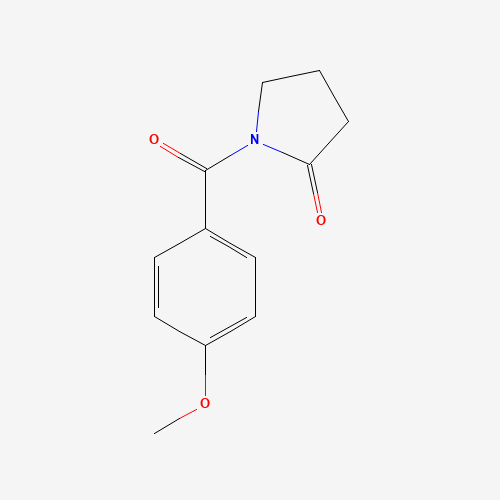
O związku Aniracetam
Aniracetam to związek chemiczny zarejestrowany pod numerem CAS 72432-10-1 o wzorze sumarycznym C12H13NO3 i masie molowej 219.24 g/mol.
Cząsteczka zawiera 29 atomów połączonych 30 wiązaniami chemicznymi. Pełna nazwa systematyczna IUPAC dla tego związku to 1-(4-methoxybenzoyl)pyrrolidin-2-one. Powyższy interaktywny model 3D pozwala obejrzeć układ przestrzenny atomów — można go obracać przeciągnięciem myszką, powiększać scrollem oraz przełączać między trybami wizualizacji szkieletowy / Ball & Stick / Space Fill.
Pod względem właściwości fizykochemicznych współczynnik podziału logP = 1.6 (wartość dodatnia, związek lipofilowy), powierzchnia polarna PSA = 46.6 Ų, 0 donorów i 3 akceptorów wiązań wodorowych. Te parametry są kluczowe przy ocenie biologicznej dostępności i interakcji z biomolekułami.
Dane chemiczne dla tego związku pochodzą z PubChem (NIH NLM NCBI), jednej z największych baz związków chemicznych na świecie. Wszystkie informacje są aktualizowane automatycznie i wzbogacone o polskie tłumaczenia zwrotów GHS zgodne z Rozporządzeniem CLP (1272/2008/WE). Powyższy widget można używać do celów edukacyjnych, badawczych i komercyjnych.
Właściwości fizykochemiczne
| Wzór sumaryczny | C12H13NO3 |
| Masa molowa | 219.24 g/mol |
| IUPAC | 1-(4-methoxybenzoyl)pyrrolidin-2-one |
| SMILES | — |
| InChIKey | ZXNRTKGTQJPIJK-UHFFFAOYSA-N |
| logP (XLogP3) | 1.6 |
| PSA | 46.6 Ų |
| HBD / HBA | 0 / 3 |
| PubChem CID | CID 2196 ↗ |
Bezpieczeństwo GHS
Sygnał:
H361 — Podejrzewa się, że działa szkodliwie na płodność lub na dziecko w łonie matki
Literatura naukowa
Literatura naukowa
20 artykułów · 2 open access · Źródła: PubMed, OpenAlex, Semantic Scholar
The study of the pH-rate profile was evaluated and it was found that aniracetam is stable in uncatalyzed degradation compared to the acid or base-catalyzed reaction and therefore the proposed RP-HPLC method could be successfully used in quality control laboratories for the determination of anir acetam and detection of degradation products.
The potentiation of the AMPA/kainate receptor by aniracetam depends on both species of agonists and subunit composition of the receptor.
Findings indicate that SHRSP have a dopaminergic hypofunction throughout the brain and that aniracetam elicits a site-specific activation in mesocorticolimbic dopaminaergic and serotonergic pathways inSHRSP, possibly via nicotinic acetylcholine receptors in the ventral tegmental area and raphe nuclei.
Findings suggest that the protective effect of aniracetam is mediated by PI 3-kinase and MEK pathways in the downstream mechanisms.
It is concluded that aniracetam exerts a dual effect on glutamatergic transmission: modulation of NMDA receptor function at nanomolar concentrations, and modulation of AMPA receptors at high micromolar concentrations.
The 90% confidence limits calculated for A UC and Cmax of aniracetam were within the standard bioequivalence range (80%-125% for AUC and C max) and can be regarded as bioequivalent to the anir acetam reference formulation.
Clinical efficacy of aniracetam on delirium associated with the sequelae of cerebrovascular diseases may be partly due to the indirect regulation of serotonergic functions via an inhibitory cholinergic mechanism.
The results indicate that aniracetam acts more effective when the forced swim stress-induced immobility is accompanied with brain dysfunction that occurs with aging.
A good linearity of aniracetam was obtained within 10-110 μg·mL-1(r=0.999 8) and the average recovery was 100.1%.
The method effectively controls release of aniracetam and reduces irritation of medicines to the gastrointestinal tract, and the method is simple to operate, is suitable for large-scale industrial production, and has large application values.
Dane z PubMed (NIH NLM), OpenAlex (CC0), Semantic Scholar (AI2). AI Summary wygenerowane przez Semantic Scholar TLDR. Artykuły z ikoną wymagają płatnego dostępu.
Synonimy
Źródła danych
- 📊 PubChem CID 2196 — NIH
- 🔬 NIST WebBook — spektroskopia
- 🌐 Wikidata
- 💊 ChEMBL — bioaktywność
