
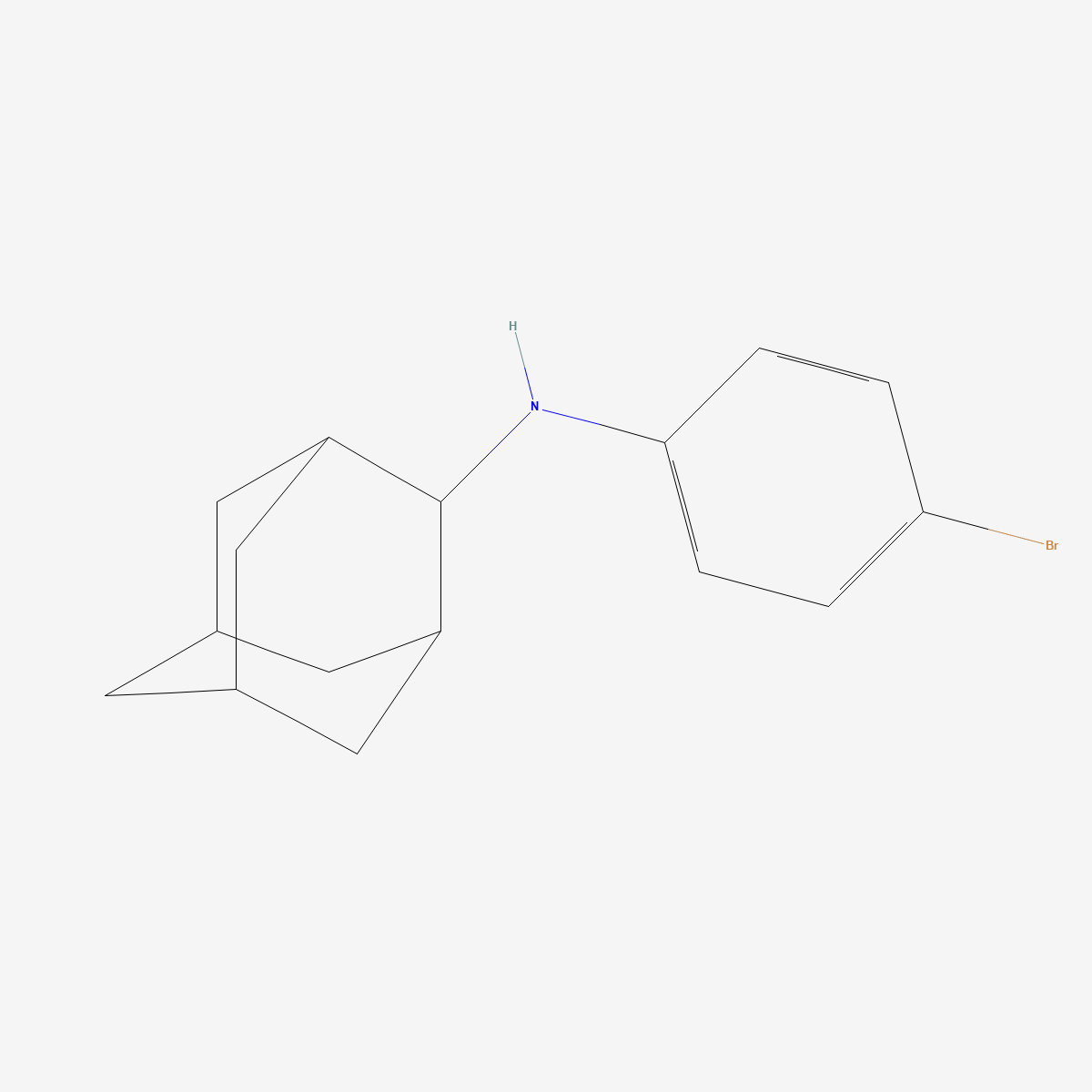
Most compounds that increase wakefulness do so by pushing neurotransmitter release or blocking reuptake. Bromantane does neither. Four decades of mostly Russian-language pharmacology describe something stranger: a molecule that appears to change how much dopamine-synthesising machinery a neuron builds, rather than how that machinery behaves once built. This is a summary of what the primary literature actually reports — including where it is thin.
Key points
- Structure: bromantane is N-(2-adamantyl)-N-(4-bromophenyl)amine (CAS 87913-26-6, C16H20BrN, MW 306.24) — an adamantane cage joined to a brominated aromatic ring.
- Proposed mechanism: upregulation of tyrosine hydroxylase and aromatic L-amino acid decarboxylase expression, i.e. an effect on dopamine synthesis capacity rather than on release or reuptake.
- Onset profile: a genomic mechanism predicts slow onset and no acute rush — which matches what the human trials describe.
- Evidence quality: one placebo-controlled trial in neurasthenia, several open studies, and a body of rodent work. Most of it is published in Russian-language journals and has not been independently replicated in Western laboratories.
- Status: supplied as a reference standard for laboratory research. Not a medicine and not for human or animal consumption.
An adamantane cage with an unusual job
Adamantane derivatives have an established place in pharmacology — amantadine and memantine are the familiar examples. The cage is rigid, highly lipophilic and metabolically stubborn, which tends to give these molecules long residence times and easy passage across the blood-brain barrier. Bromantane takes that scaffold and attaches a 4-bromophenylamine group.
The interesting part is what this combination does not do. Amantadine and memantine act largely at NMDA receptors and on dopamine release. The effects reported for bromantane survive experimental manipulations that would abolish a simple releasing agent’s action, and that observation is what pushed researchers towards a transcriptional explanation rather than a synaptic one.
Evidence for a synthesis-side mechanism
The clearest mechanistic work comes from neurochemical studies in rats. Davydova and colleagues examined monoamine synthesis using NSD-1015, an aromatic amino acid decarboxylase inhibitor that causes L-DOPA to accumulate — a standard way to read out how fast tyrosine hydroxylase is working. Bromantane altered the accumulation pattern across brain structures, consistent with an effect at the synthesis step rather than at the synapse.[6]
Proteomic work points the same way. Yamidanov and colleagues used two-dimensional electrophoresis with mass spectrometry to identify proteins in rat brain whose abundance changed after administration — an approach that presupposes, correctly for this compound, that the relevant action is a change in the protein complement of the cell.[5]
This matters for anyone designing an assay. A compound acting on transcription and translation will not produce a signal in a short receptor-binding screen. The experimental window has to be long enough for protein levels to move, which in practice means hours to days rather than minutes. Screens that failed to detect activity may have been measuring the wrong timescale rather than measuring an inactive compound.
What the human trials actually showed
The pivotal clinical work is a comparative study against placebo in patients diagnosed with neurasthenia, reported by Neznamov and colleagues in 2009. The design ran 28 days of monotherapy followed by a one-week placebo period intended to detect withdrawal phenomena. The authors reported superiority over placebo in both the rate and the degree of reduction of asthenic symptoms, and attributed the result to an unusual combination of psychostimulant and anxiolytic properties in a single molecule.[1] An earlier pilot study by Siuniakov and colleagues had established the basic tolerability picture.[2]
A separate study in healthy volunteers examined psychophysiological parameters rather than symptom scores, which is the more informative design for a compound claimed to affect performance in subjects who are not fatigued to begin with.[3] The same group later reported that response tracked EEG alpha-rhythm type — an attempt to identify who responds rather than whether the average patient does.[7]
Two caveats belong in any honest summary. First, nearly all of this work originates from a small number of affiliated Russian institutions, and independent replication outside that network is essentially absent. Second, the trials use diagnostic categories — neurasthenia, asthenic syndrome — that do not map cleanly onto DSM-5 or ICD-11 constructs, which makes comparison with Western literature awkward. Neither caveat makes the findings wrong. Both mean the evidence base is narrower than the raw publication count suggests.
The immunological thread
A less-cited line of work examined effects on immune parameters. Tallerova and colleagues reported changes in T-lymphocyte subpopulation composition in C57BL/6 mice under an anxious-depressive model,[4] and in related work measured cytokine levels alongside behavioural readouts.[8] Whether this reflects a direct immunological action or a downstream consequence of altered monoamine signalling is not settled by these studies. It is, however, a useful reminder that a transcriptional mechanism is unlikely to confine itself neatly to one tissue.
Practical notes for laboratory handling
The lipophilicity conferred by the adamantane cage means poor aqueous solubility; stock solutions are typically prepared in DMSO. The secondary aromatic amine and the carbon–bromine bond are the two reactive handles worth considering: store protected from light, and treat prolonged exposure to strong oxidants as a plausible degradation route. As with any brominated aromatic, verify identity by melting point and spectroscopic methods rather than assuming label accuracy.
Frequently asked questions
Is bromantane a stimulant?
Pharmacologically it is classified as an actoprotector rather than a stimulant, and the distinction is not cosmetic. Classical stimulants act on transmitter release or reuptake and produce acute effects within minutes; the mechanism described for bromantane operates through changes in enzyme expression and would be expected to act over a far longer timescale.
Why is most of the research published in Russian?
The compound was developed in the Soviet Union and subsequent work has been concentrated in institutions descended from that programme. Several key papers are indexed in PubMed with English abstracts but appeared in Russian-language journals, which has limited their visibility in Western pharmacology and is part of why the compound remains poorly characterised outside that literature.
Is bromantane detectable in anti-doping testing?
Yes. Bromantane appears on the World Anti-Doping Agency Prohibited List and validated detection methods exist. Researchers working in sports-science contexts should treat the compound accordingly.
What purity is appropriate for a reference standard?
For analytical work, material characterised at ≥99% with a stated assay method is the practical minimum. Our bromantane reference standard, assayed at ≥99.75% purity, ships with identity documentation available on request.
Related compounds in our catalogue
Researchers comparing wakefulness-associated compounds with distinct mechanisms frequently work alongside modafinil reference material (CAS 68693-11-8), which acts through dopamine transporter binding rather than enzyme induction, and L-DOPA (CAS 59-92-7), the direct substrate of the decarboxylase step discussed above.
References
- Neznamov GG, Siuniakov SA, Teleshova SE, Chumakov DV, Reutova MA, Siuniakov TS, Mametova LE, Dorofeeva OA, Grishin SA. Ladasten, the new drug with psychostimulant and anxiolytic actions in treatment of neurasthenia (results of the comparative clinical study with placebo). Zh Nevrol Psikhiatr Im S S Korsakova. 2009;109(5):20–26. PMID: 19491814
- Siuniakov SA, Grishin SA, Teleshova ES, Neznamov GG, Seredenin SB. Pilot clinical trial of ladasten. Eksperimental’naia i Klinicheskaia Farmakologiia. 2006;69(4):10–15. PMID: 16995430
- Bogdan NG, Kolotilinskaia NV, Iarkova MA, Nadorov SA, Badyshtov BA, Seredenin SB. Effect of ladasten on the psychophysiological parameters of healthy volunteers. Eksperimental’naia i Klinicheskaia Farmakologiia. 2009;72(3):3–9. PMID: 19642584
- Tallerova AV, Kovalenko LP, Kuznetsova OS, Durnev AD, Seredenin SB. Correcting effect of ladasten on variations in the subpopulation composition of T lymphocytes in C57BL/6 mice on the experimental model of an anxious-depressive state. Bulletin of Experimental Biology and Medicine. 2014;156(3):335–337. doi:10.1007/s10517-014-2343-1
- Yamidanov RS, Salimgareeva MKh, Sadovnikov SV, Vakhitova YV, Govorun VM, Seredenin SB. Proteomic analysis and identification of ladasten target proteins in rat brain. Bulletin of Experimental Biology and Medicine. 2010;149(6):775–778. doi:10.1007/s10517-010-1050-9
- Davydova AI, Klodt PM, Kudrin VS, Kuznetsova EA, Narkevich VB. Neurochemical study of the effects of the new anxiolytic drugs afobazol and ladasten on the synthesis and metabolism of monoamines and their metabolites in brain structures of Wistar rats in a model of monoamine synthesis blockade induced by the aromatic amino acid decarboxylase inhibitor NSD-1015. Eksperimental’naia i Klinicheskaia Farmakologiia. 2010;73(3):2–6. PMID: 20408420
- Neznamov GG, Bochkarev VK, Reutova MA, Shabanova AA, Siuniakov SA. Ladasten versus placebo effect self-evaluated by neurasthenia patients with different EEG alpha rhythm types. Eksperimental’naia i Klinicheskaia Farmakologiia. 2012;75(5):7–13. PMID: 22834121
- Tallerova AV, Kovalenko LP, Durnev AD, Seredenin SB. Effect of the antiasthenic drug ladasten on cytokine levels and behaviour in an experimental model of anxious depression in C57BL/6 male mice. Eksperimental’naia i Klinicheskaia Farmakologiia. 2011;74(11):3–5. PMID: 22288152
Research use only. The compounds discussed are supplied as reference standards for laboratory research. They are not medicines, not dietary supplements, and are not for human or animal consumption. Nothing in this article is medical advice or a recommendation for use in humans. Any quantities mentioned are those reported in the published studies cited above and appear solely to describe that research accurately.