Modafinil was introduced with a claim that has aged badly: that it promoted wakefulness through some mechanism other than the one amphetamines use. Two decades of genetics, electrophysiology and human imaging have since converged on an unglamorous answer — it binds the dopamine transporter, and without that transporter it does almost nothing. What the transporter account still does not explain is why a compound occupying roughly half the striatal transporter population behaves so little like methylphenidate.
Key points
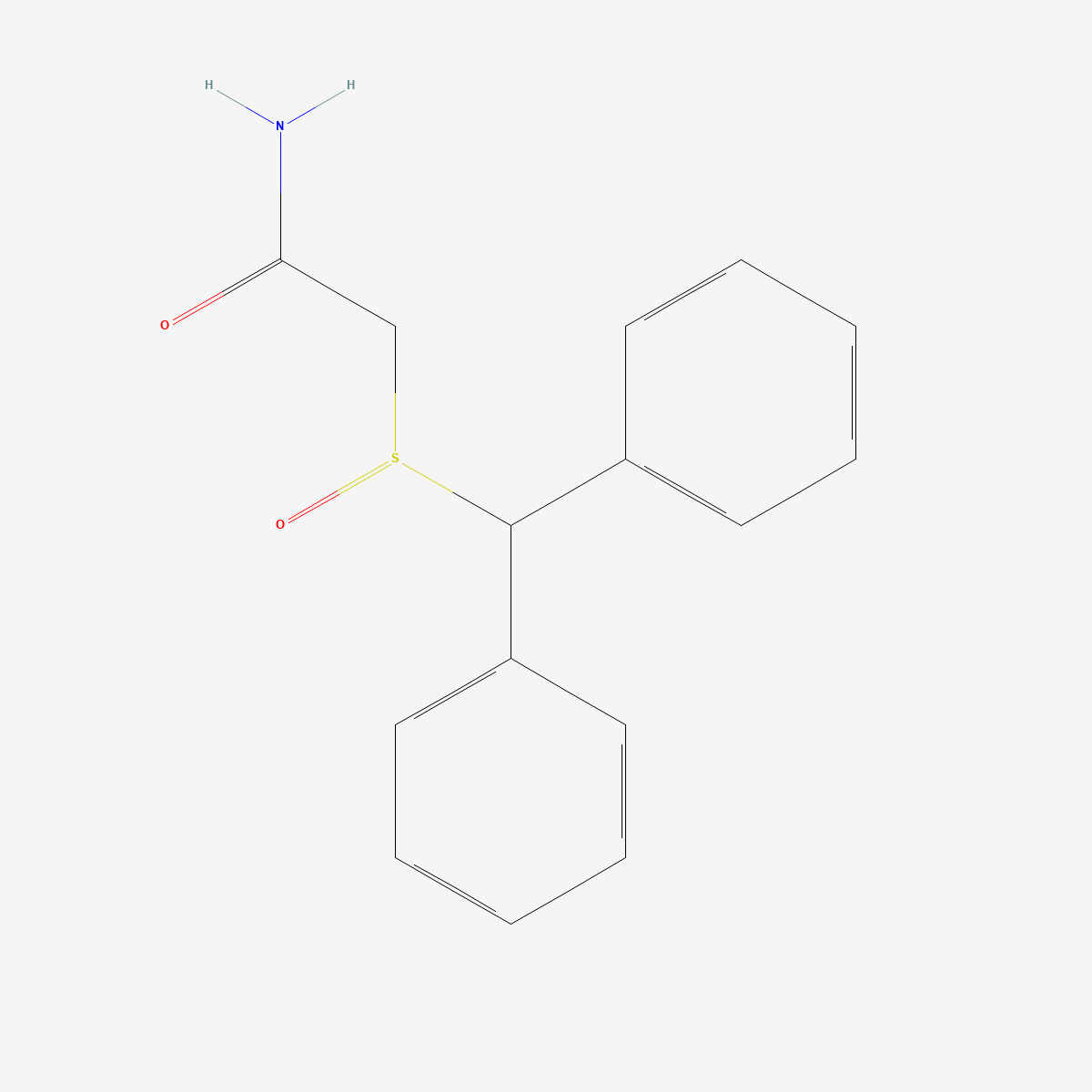
- Structure: modafinil is 2-[(diphenylmethyl)sulfinyl]acetamide (CAS 68693-11-8, C15H15NO2S, MW 273.35) — a benzhydryl sulfoxide carrying a primary amide, with the stereocentre at sulfur rather than at carbon.
- Primary molecular target: the dopamine transporter (DAT). Deleting the transporter, or mutating its cocaine-binding site, abolishes the wake-promoting and locomotor effects in mice.[2][4]
- Human occupancy: positron emission tomography put mean striatal DAT occupancy at 51.4% after 200 mg and 56.9% after 300 mg in ten healthy volunteers — a figure the investigators themselves described as close to methylphenidate.[5]
- Orexin is not required: modafinil increased wakefulness more in orexin-null mice than in wild-type littermates, which is the opposite of what an orexin-mediated mechanism predicts.[3]
- “Atypical” is a structural claim: molecular dynamics work on modafinil analogues ties the atypical profile to the sulfoxide oxygen and to which transporter conformation the ligand stabilises, not to a vague dissimilarity from stimulants.[7]
- Status: supplied as a reference standard for laboratory research. Not a medicine and not for human or animal consumption.
A sulfoxide with its stereocentre in an unusual place
Most chiral drugs are chiral at carbon. Modafinil is not: the benzhydryl group and the acetamide arm are joined through a sulfinyl bridge, and it is the sulfur, bearing a lone pair, that makes the molecule chiral. That single oxygen does more work than it appears to. Reduce the sulfoxide to a sulfide and you have a closely related compound with different transporter pharmacology; the pair differ by one atom and fall on opposite sides of what medicinal chemists call an activity cliff.[7]
For anyone handling the material, the sulfoxide is also the reactive handle worth thinking about. Sulfoxides sit midway on the sulfur oxidation ladder, and further oxidation to the sulfone is the degradation route to design storage against. The amide is comparatively inert. Aqueous solubility is poor, which is why in vitro work generally starts from a DMSO stock rather than from buffer.
The transporter evidence came from genetics before it came from imaging
The cleanest mechanistic result predates the human imaging by eight years. Wisor and colleagues recorded sleep polygraphically in mice lacking the dopamine transporter gene and found them unresponsive to the normally robust wake-promoting action of modafinil, methamphetamine and the selective transporter blocker GBR12909 — while remaining hypersensitive to caffeine, which does not act at the transporter. The same study showed that modafinil raised extracellular dopamine in narcoleptic dogs in a manner independent of hypocretin receptor 2.[2]
A knockout removes the protein entirely, so a sceptic can always argue that the phenotype reflects developmental compensation rather than the acute drug target. Federici and colleagues closed that gap with a more selective genetic tool: cocaine-insensitive DAT knock-in mice, which express a transporter that still works but no longer binds ligands at the cocaine site. In slices from wild-type animals modafinil inhibited the spontaneous firing of substantia nigra pars compacta dopamine neurons and augmented stimulus-evoked striatal dopamine overflow; in the knock-in animals neither the electrophysiological nor the behavioural effects appeared.[4] The compound needs that specific binding pocket, not merely a functioning transporter.
What positron emission tomography measured in humans
Volkow and colleagues gave ten healthy male participants 200 mg or 400 mg orally and scanned them with two radioligands: [11C]raclopride, which reports changes in endogenous dopamine, and [11C]cocaine, which reports transporter occupancy. Both moved. Raclopride binding potential fell by 6.1% in caudate, 6.7% in putamen and 19.4% in nucleus accumbens, reflecting increases in extracellular dopamine, while cocaine binding potential fell by 53.8%, 47.2% and 39.3% in the same three structures.[1] The authors framed the accumbens result as grounds for heightened awareness of abuse potential rather than as reassurance.
Kim and colleagues repeated the occupancy measurement with [18F]FE-PE2I, a higher-affinity and more selective transporter ligand, and obtained 51.4% at 200 mg and 56.9% at 300 mg, correlated with plasma concentration.[5] In cocaine-dependent patients studied under a randomised double-blind design, two weeks of treatment reduced [11C]-PE2I binding potential by 65.6%, with no significant change under placebo.[6] Three laboratories, three radioligands, one conclusion. Whatever else modafinil does, it occupies the dopamine transporter at the concentrations reached in those studies.
The orexin hypothesis and why it did not survive
Before the transporter data accumulated, the leading alternative was orexin. Fos immunohistochemistry had shown that orexin neurons are activated after administration, and the principal clinical use of the compound is in narcolepsy, a disorder of orexin deficiency — the inference was a natural one to draw. Willie and colleagues tested it directly in orexin-knockout mice and found that modafinil produced similar neuronal activation patterns in both genotypes and increased wakefulness time more effectively in the null animals than in their wild-type littermates.[3]
That is not a null result; it points the wrong way for the hypothesis under test. The authors concluded that orexin is not required for the wakefulness-prolonging action, while leaving open that orexin may mediate part of the alerting effect — spectral analysis showed the compound only partly compensated for the reduced theta-band power characteristic of awake orexin-null mice. It is a useful example of a mechanism that was plausible, well-motivated and wrong, and it is worth remembering when reading the many reviews that still list orexin among the primary actions.
Where the transporter account runs out
If modafinil were simply a slow methylphenidate, its epidemiology should resemble that of methylphenidate. It does not. Reviewing the pharmacology for a 2024 volume, Hersey and Tanda note that only a few cases of dependence have been reported despite transporter inhibition shared with addictive psychostimulants, and that the compound has itself been tested, with some success, as a candidate treatment for psychostimulant use disorders.[8] They describe the mechanisms underlying its therapeutic efficacy as remaining largely elusive — a fair summary of a field in which the primary target is settled and its consequences are not.
Part of the answer is probably conformational. Sulfoxide-substituted modafinil analogues attract more water into the binding pocket, tend to dissociate from Asp79 and form a new interaction with Asp421, promoting an inward-facing transporter conformation; sulfide-substituted analogues do not.[7] Two ligands can occupy the same site, block uptake comparably, and leave the transporter in different conformational states. That is a mechanistic basis for a behavioural difference which occupancy percentages alone cannot capture, and it is the reason the word “atypical” has started to earn its place in this literature.
The cognitive literature adds its own caution. A systematic review restricted to healthy, non-sleep-deprived humans found that simple testing paradigms gave inconsistent results — roughly half showed improvement in attention, learning and memory, and a few reported impairment in divergent creative thinking — whereas more complex assessments produced more consistent enhancement of attention, executive function and learning.[9] The magnitude and occasionally the direction of the measured effect depends on the instrument. Anyone designing a behavioural assay around this compound should treat that as a measurement problem to be solved rather than as noise to be averaged away.
Practical notes for laboratory handling
Modafinil is supplied as a racemate unless a resolved enantiomer is specified, and the two sulfur enantiomers differ in elimination kinetics, so an experiment sensitive to exposure over time should record which material was used. Identity should be confirmed spectroscopically rather than assumed from the label: the diphenylmethyl signature is straightforward by NMR, and the sulfoxide is readily distinguished from its sulfone oxidation product by mass. Store protected from oxidants, and prepare DMSO stocks fresh for uptake assays, where residual solvent itself perturbs transporter function at higher percentages.
Frequently asked questions
Is modafinil a dopamine reuptake inhibitor like cocaine or methylphenidate?
At the level of molecular target, yes. It binds the dopamine transporter at the cocaine site, and cocaine-insensitive knock-in mice do not respond to it.[4] Human occupancy figures fall in a range the investigators compared directly to methylphenidate.[5] The differences between these compounds are therefore differences in binding kinetics, conformational preference and pharmacokinetics, not differences in which protein they bind.
Does modafinil work through orexin?
Not primarily. Genetic deletion of orexin does not abolish the wake-promoting effect; it enhances it.[3] Orexin neurons are activated after administration, but activation downstream of a dopaminergic action is a sufficient explanation for that observation, and the knockout result excludes orexin as the necessary pathway.
Why do reviews describe modafinil as an “atypical” stimulant?
Because the phenotype does not follow from the target in the expected way: transporter inhibition shared with classical psychostimulants, but few reported cases of dependence, alongside additional and less well-characterised actions on GABA, glutamate, serotonin and noradrenaline systems.[8] Recent structural work turns “atypical” into a testable claim about which transporter conformation a ligand stabilises, rather than a label for a clinical impression.[7]
What purity is appropriate for a reference standard?
For transporter binding or uptake assays, where a catecholaminergic contaminant present at a fraction of a percent could shift a measured IC50, material characterised at ≥99% with a stated assay method is the practical minimum. Our modafinil reference material (CAS 68693-11-8), assayed at ≥99% purity, ships with identity documentation available on request.
Related compounds in our catalogue
Laboratories working on structure–activity relationships within this chemical series frequently pair the parent compound with the fluorinated modafinil analogue flmodafinil (CAS 90280-13-0), in which both phenyl rings carry a fluorine substituent, and — as a wakefulness-associated comparator with an entirely different proposed mechanism — with bromantane reference standard (CAS 87913-26-6), which is described as acting on dopamine synthesis enzymes rather than on the transporter.
References
- Volkow ND, Fowler JS, Logan J, Alexoff D, Zhu W, Telang F, Wang GJ, Jayne M, Hooker JM, Wong C, Hubbard B, Carter P, Warner D, King P, Shea C, Xu Y, Muench L, Apelskog-Torres K. Effects of modafinil on dopamine and dopamine transporters in the male human brain: clinical implications. JAMA. 2009;301(11):1148–1154. doi:10.1001/jama.2009.351 · PMID: 19293415
- Wisor JP, Nishino S, Sora I, Uhl GH, Mignot E, Edgar DM. Dopaminergic role in stimulant-induced wakefulness. The Journal of Neuroscience. 2001;21(5):1787–1794. doi:10.1523/JNEUROSCI.21-05-01787.2001 · PMID: 11222668
- Willie JT, Renthal W, Chemelli RM, Miller MS, Scammell TE, Yanagisawa M, Sinton CM. Modafinil more effectively induces wakefulness in orexin-null mice than in wild-type littermates. Neuroscience. 2005;130(4):983–995. doi:10.1016/j.neuroscience.2004.10.005 · PMID: 15652995
- Federici M, Latagliata EC, Rizzo FR, Ledonne A, Gu HH, Romigi A, Nisticò R, Puglisi-Allegra S, Mercuri NB. Electrophysiological and amperometric evidence that modafinil blocks the dopamine uptake transporter to induce behavioral activation. Neuroscience. 2013;252:118–124. doi:10.1016/j.neuroscience.2013.07.071 · PMID: 23933217
- Kim W, Tateno A, Arakawa R, Sakayori T, Ikeda Y, Suzuki H, Okubo Y. In vivo activity of modafinil on dopamine transporter measured with positron emission tomography and [18F]FE-PE2I. International Journal of Neuropsychopharmacology. 2014;17(5):697–703. doi:10.1017/S1461145713001612 · PMID: 24451483
- Karila L, Leroy C, Dubol M, Trichard C, Mabondo A, Marill C, Dubois A, Bordas N, Martinot JL, Reynaud M, Artiges E. Dopamine transporter correlates and occupancy by modafinil in cocaine-dependent patients: a controlled study with high-resolution PET and [11C]-PE2I. Neuropsychopharmacology. 2016;41(9):2294–2302. doi:10.1038/npp.2016.28 · PMID: 26892922
- Lee KH, Camacho-Hernandez GA, Newman AH, Shi L. The structural basis of the activity cliff in modafinil-based dopamine transporter inhibitors. Biomolecules. 2024;14(6):713. doi:10.3390/biom14060713 · PMID: 38927116
- Hersey M, Tanda G. Modafinil, an atypical CNS stimulant? Advances in Pharmacology. 2024;99:287–326. doi:10.1016/bs.apha.2023.10.006 · PMID: 38467484
- Battleday RM, Brem AK. Modafinil for cognitive neuroenhancement in healthy non-sleep-deprived subjects: a systematic review. European Neuropsychopharmacology. 2015;25(11):1865–1881. doi:10.1016/j.euroneuro.2015.07.028 · PMID: 26381811
Research use only. The compounds discussed are supplied as reference standards for laboratory research. They are not medicines, not dietary supplements, and are not for human or animal consumption. Nothing in this article is medical advice or a recommendation for use in humans. Any quantities mentioned are those reported in the published studies cited above and appear solely to describe that research accurately.