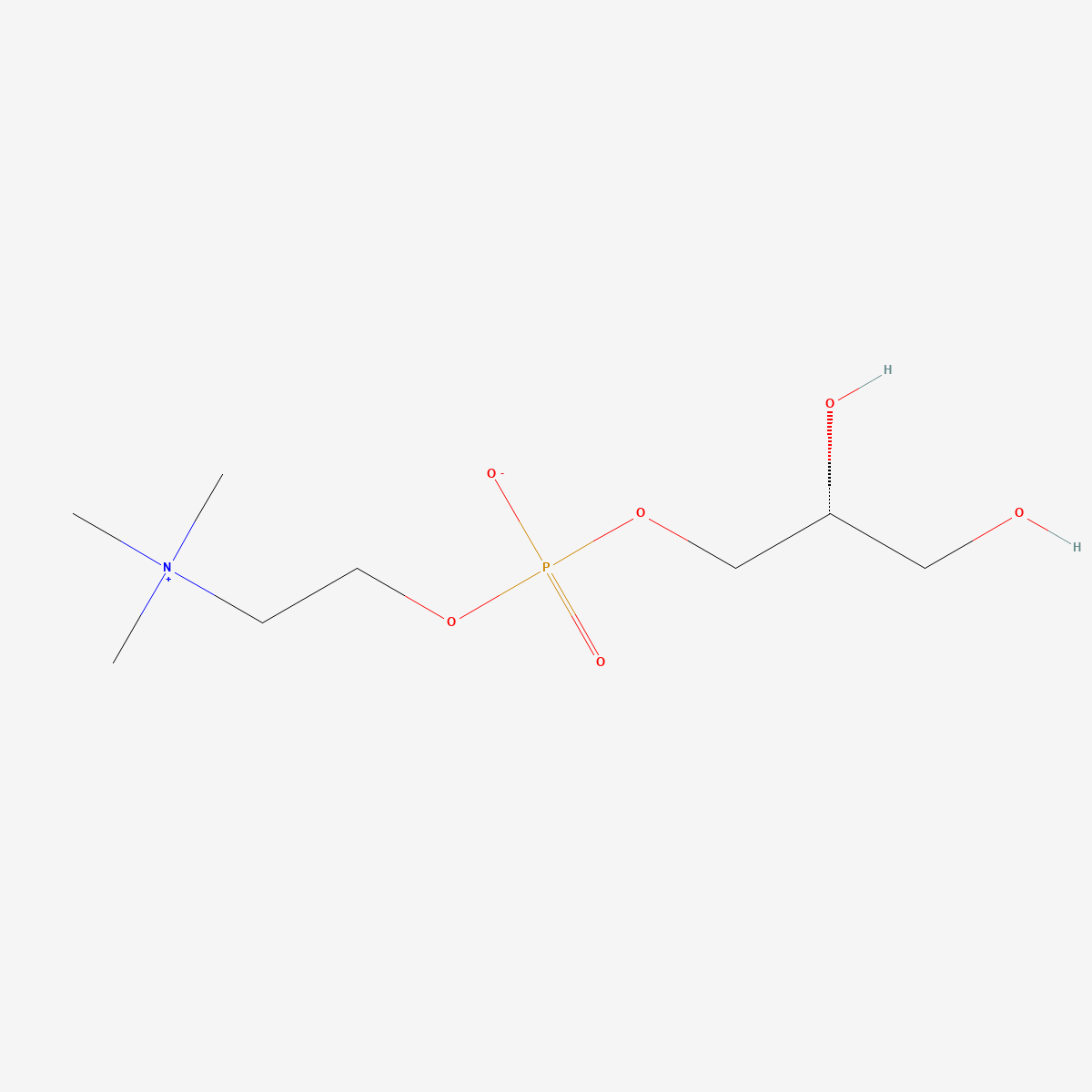
Alpha-GPC has no receptor. Nothing in the published pharmacology describes it binding a target, and that absence is the mechanism rather than a gap in it: the compound is a naturally occurring phospholipid metabolite whose entire reported activity runs through the free choline it releases. This makes the interesting question a delivery question. Choline and lecithin were tried as precursor loads decades ago and well-controlled trials did not confirm a clinical utility for them — so any claim for alpha-GPC has to explain what its delivery does differently, and the literature has an answer that can be checked.
Key points
- Identity: L-alpha-glycerylphosphorylcholine (CAS 28319-77-9, C8H20NO6P, MW 257.22), a zwitterionic glycerophospholipid metabolite, referred to throughout the clinical literature as choline alfoscerate or choline alphoscerate.
- Proposed mechanism: cleavage to glycerophosphate and free choline, expanding the acetylcholine precursor pool — not activity at a receptor or transporter of its own.[1]
- Isotopic evidence: intravenous [14C]alpha-GPC resulted in [14C]acetylcholine formation, alongside dose-dependent increases in hippocampal acetylcholine release measured by microdialysis.[2]
- Delivery comparison: after intramuscular administration of 1000 mg in 12 volunteers, plasma free choline rose rapidly with peak levels at 0.25–0.5 h, and the rise was considerably larger than after the same dose of citicoline.[3]
- Clinical base: a 261-patient placebo-controlled trial in Alzheimer-type dementia and a meta-analysis of seven randomised trials, both reporting positive effects — with authorship concentrated in a small number of groups.[5][6]
- Status: supplied as a reference standard for laboratory research. Not a medicine, not a supplement, and not for human or animal consumption.
A metabolite used as a drug
Alpha-GPC sits on the normal catabolic route of phosphatidylcholine, which means that unlike most compounds discussed under pharmacology it has an endogenous concentration and an endogenous turnover before anything is administered. The consequence for mechanism is structural: there is no orphan receptor to find, and experiments designed to locate one will return nothing. The testable claims are instead about flux — does administered material reach the acetylcholine pool, how fast, and does the resulting change in precursor availability alter transmission in tissue where synthesis is rate-limiting.
The first of those questions was addressed in rats with a straightforward design. Orally administered alpha-GPC reversed scopolamine-induced amnesia in passive avoidance, with a peak effect at 600 mg/kg given intragastrically 5 h before training, and an effect lasting up to 30 h consistent with the compound’s pharmacokinetics. Administered by that route it is cleaved within gut mucosal cells to glycerophosphate and free choline. It partially counteracted the scopolamine-induced fall in brain acetylcholine in hippocampus and cortex — but not in striatum — and in ex vivo experiments increased the acetylcholine released from hippocampal slices after potassium stimulation.[1] The regional dissociation is worth noting: a precursor effect appears where it appears, and is not a uniform increase in cholinergic tone.
Tracing the label into acetylcholine
A second group reached the same conclusion with the more direct experiment. Oral alpha-GPC given 3 h before testing prevented scopolamine-induced learning impairment, and also completely reversed retrograde amnesia when scopolamine was given immediately after acquisition training, with a dose maximum at 300 mg/kg. Hippocampal acetylcholine release, measured both by in vivo microdialysis and in vitro in tissue slices, increased dose-dependently with the same 300 mg/kg maximum. Crucially, intravenous injection of [14C]alpha-GPC resulted in [14C]acetylcholine formation.[2]
That isotopic result is the load-bearing evidence for the whole precursor hypothesis. Without it, a rise in acetylcholine release after alpha-GPC would be compatible with several indirect explanations; with it, carbon from the administered molecule is demonstrably incorporated into the transmitter.
Why the delivery form is the actual variable
If the mechanism is choline delivery, then comparisons between choline sources are the informative experiment. Twelve normal volunteers were studied on three randomised occasions — a no-drug control day to establish the endogenous plasma choline profile, a 1000 mg intramuscular dose of alpha-GPC, and a 1000 mg intramuscular dose of citicoline — with at least a week of washout between sessions and plasma choline determined by HPLC over 6 h. Endogenous levels were stable through the control session. Alpha-GPC produced a rapid rise with peak levels usually at the first (0.25 h) or second (0.5 h) sampling point, declining gradually towards baseline by the end of the observation period. Citicoline produced a similar time course but at considerably lower concentrations.[3]
Two caveats belong with that result. The route was intramuscular, so it does not directly describe what an oral dose does, and the comparison is between two choline-donating compounds rather than against elemental choline. What it does establish is that the identity of the carrier changes the plasma choline excursion for an equal nominal dose — which is exactly the kind of difference that could separate alpha-GPC from the earlier, unsuccessful precursor-loading attempts with choline and lecithin.[5]
Growth hormone as a read-out of cholinergic tone
One line of work used the growth hormone axis as an indirect assay for cholinergic activity rather than as an endpoint of interest in itself. The rationale is that growth hormone secretion declines with age, possibly through increased hypothalamic somatostatin release, which cholinergic agonists inhibit. Growth hormone-releasing hormone was administered to young and old volunteers with and without alpha-GPC. Responses were larger in the younger subjects, both groups responded more strongly to GHRH plus alpha-GPC than to GHRH alone, and the potentiating effect was more pronounced in the elderly.[4]
This is frequently cited out of context as evidence that alpha-GPC raises growth hormone. It does not show that. It shows potentiation of a provoked response to an exogenous secretagogue, in a design built to probe cholinergic tone. A more recent crossover study in healthy resistance-trained men that measured growth hormone after a bout of lower-body resistance exercise rather than after GHRH found no group differences in growth hormone at all.[8] The two results are not in conflict; they are answers to different questions, and only the first is about cholinergic pharmacology.
The clinical record, read carefully
The anchor trial is a multicentre, double-blind, randomised, placebo-controlled study in mild to moderate Alzheimer-type dementia. A total of 261 patients (132 active, 129 placebo) received 400 mg capsules three times daily or placebo for 180 days. Mean ADAS-Cog score in the treated group fell by 2.42 points at 90 days and by 3.20 points at 180 days, while in the placebo group it rose by 0.36 points at 90 days and by 2.90 points at 180 days; MMSE, GDS, ADAS-Total and CGI moved consistently in the same direction, with statistically significant between-treatment differences at both time points for several scales.[5] Note what generates most of the separation: the treated group improved modestly, and the placebo group declined, as an untreated dementia cohort does.
A systematic review and meta-analysis screened 1326 studies and 300 full texts, including seven randomised controlled trials and one prospective cohort. It reported significant effects of alpha-GPC combined with donepezil on cognition (4 RCTs, mean difference 1.72, 95% CI 0.20 to 3.25), on functional outcomes (3 RCTs, MD 0.79, 95% CI 0.34 to 1.23) and on behavioural outcomes (4 RCTs, MD −7.61, 95% CI −10.31 to −4.91), and better cognition for patients receiving alpha-GPC than placebo or other medications (MD 3.50, 95% CI 0.36 to 6.63).[6] An independent multicentre randomised placebo-controlled trial in 100 subjects with mild cognitive impairment, using 600 mg daily for 12 weeks, reported an ADAS-Cog decrease of 2.34 points greater than placebo, with no serious adverse events and no difference in adverse event incidence.[7]
The honest qualification is about concentration of authorship rather than about the statistics. Several of the trials pooled in that meta-analysis, and the meta-analysis itself, share authors from the same institution, and much of the combination-therapy evidence derives from one long-running trial programme. That does not make the results wrong. It does mean the field has fewer independent replications than the citation count suggests, and the Korean mild cognitive impairment trial is valuable partly because it comes from outside that network.
Healthy subjects: a much thinner base
Evidence in people without cognitive impairment is limited and mixed. A randomised, double-blind, placebo-controlled crossover study in 20 resistance-trained men compared 630 mg and 315 mg against placebo, with cognitive testing 60 min after ingestion and again after resistance exercise. Stroop total score changed more after the high dose (13.0 ± 8.2 versus 5.2 ± 9.0, p = 0.013, d = 0.61) and after the low dose (10.8 ± 7.7 versus 5.2 ± 9.0, p = 0.046, d = 0.48), with faster Stroop completion in the high-dose condition; there were no significant differences for the Flanker and N-Back assessments, for visual analogue scales, for physical performance or for growth hormone. The author discloses paid scientific advisory work for the study sponsor, with a conflict-of-interest management plan under which he was not involved in consent, data collection or pre-unblinding analysis.[8] One positive test out of three, in twenty subjects, is a preliminary signal and should be described as one.
A separate crossover study in 20 college-aged trained males found no significant difference from placebo on anaerobic exercise performance or on a computerised cognition battery — but the active arm was a combination of 500 mg alpha-glycerophosphocholine with 250 mg uridine-5′-monophosphate and 1500 mg docosahexaenoic acid given 90 min before testing, so the design cannot isolate the contribution of any one component.[9] It is a null result about a product, not about a molecule.
Practical notes for laboratory handling
Alpha-GPC is markedly hygroscopic. Material left open to ambient humidity gains mass quickly, which corrupts gravimetric preparation of standards, so weighing should be done in a dry environment and water content reported alongside any assay figure. The molecule is highly water-soluble and, as a zwitterion, poorly retained on conventional reversed-phase columns without ion-pairing or HILIC conditions — a practical consideration when purity is being verified rather than assumed. Identity work should confirm the L-configuration, since the systematic name carries stereochemistry that a generic assay does not check.
Frequently asked questions
Does alpha-GPC act on a receptor?
No such action is described in the primary literature. The mechanism reported throughout is cleavage to free choline and glycerophosphate, with the choline entering the acetylcholine precursor pool — supported most directly by the appearance of radiolabel from [14C]alpha-GPC in acetylcholine.[1][2] Studies designed around receptor binding would be looking for something the compound is not proposed to do.
How does it differ from citicoline as a choline source?
In the size of the plasma choline excursion it produces. In a within-subject comparison at 1000 mg intramuscularly, both compounds raised plasma choline with a similar time course, but concentrations after citicoline were considerably lower.[3] The two also differ in what else they deliver: citicoline additionally supplies cytidine, which alpha-GPC does not.
Is the cognitive evidence in healthy people convincing?
Not yet. The one dedicated randomised crossover trial in healthy men found an effect on Stroop performance but not on Flanker or N-Back in 20 participants, and carries a declared sponsor relationship.[8] The substantial trial evidence is in clinical populations with cognitive impairment, where a precursor mechanism has a plausible deficit to act on.[5][7]
What should an alpha-GPC reference standard be characterised for?
Assay purity, water content and stereochemical identity, since the hygroscopicity of this material makes a nominal mass unreliable without a stated moisture figure. Our alpha-GPC reference standard (CAS 28319-77-9, L-alpha-glycerylphosphorylcholine) is supplied with identity documentation available on request.
Related compounds in our catalogue
Researchers assembling a cholinergic panel frequently work alongside pramiracetam reference material (CAS 68497-62-1), whose reported activity in the primary literature converges on cholinergic terminals rather than on precursor supply, and aniracetam (CAS 72432-10-1), studied primarily as a modulator of ionotropic glutamate receptors and so a useful mechanistic contrast.
References
- Lopez CM, Govoni S, Battaini F, Bergamaschi S, Longoni A, Giaroni C, Trabucchi M. Effect of a new cognition enhancer, alpha-glycerylphosphorylcholine, on scopolamine-induced amnesia and brain acetylcholine. Pharmacology Biochemistry and Behavior. 1991;39(4):835–840. doi:10.1016/0091-3057(91)90040-9 · PMID: 1662399
- Sigala S, Imperato A, Rizzonelli P, Casolini P, Missale C, Spano P. L-alpha-glycerylphosphorylcholine antagonizes scopolamine-induced amnesia and enhances hippocampal cholinergic transmission in the rat. European Journal of Pharmacology. 1992;211(3):351–358. doi:10.1016/0014-2999(92)90392-h · PMID: 1319912
- Gatti G, Barzaghi N, Acuto G, Abbiati G, Fossati T, Perucca E. A comparative study of free plasma choline levels following intramuscular administration of L-alpha-glycerylphosphorylcholine and citicoline in normal volunteers. International Journal of Clinical Pharmacology, Therapy and Toxicology. 1992;30(9):331–335. PMID: 1428296
- Ceda GP, Ceresini G, Denti L, Marzani G, Piovani E, Banchini A, Tarditi E, Valenti G. alpha-Glycerylphosphorylcholine administration increases the GH responses to GHRH of young and elderly subjects. Hormone and Metabolic Research. 1992;24(3):119–121. doi:10.1055/s-2007-1003272 · PMID: 1577400
- De Jesus Moreno Moreno M. Cognitive improvement in mild to moderate Alzheimer’s dementia after treatment with the acetylcholine precursor choline alfoscerate: a multicenter, double-blind, randomized, placebo-controlled trial. Clinical Therapeutics. 2003;25(1):178–193. doi:10.1016/s0149-2918(03)90023-3 · PMID: 12637119
- Sagaro GG, Traini E, Amenta F. Activity of choline alphoscerate on adult-onset cognitive dysfunctions: a systematic review and meta-analysis. Journal of Alzheimer’s Disease. 2023;92(1):59–70. doi:10.3233/JAD-221189 · PMID: 36683513
- Jeon J, Lee SY, Lee S, Han C, Park GD, Kim SJ, Chang JG, Kim WJ. Efficacy and safety of choline alphoscerate for amnestic mild cognitive impairment: a randomized double-blind placebo-controlled trial. BMC Geriatrics. 2024;24(1):774. doi:10.1186/s12877-024-05366-7 · PMID: 39300341
- Kerksick CM. Acute alpha-glycerylphosphorylcholine supplementation enhances cognitive performance in healthy men. Nutrients. 2024;16(23):4240. doi:10.3390/nu16234240 · PMID: 39683633
- Bunn JA, Crossley A, Timiney MD. Acute ingestion of neuromuscular enhancement supplements do not improve power output, work capacity, and cognition. Journal of Sports Medicine and Physical Fitness. 2018;58(7-8):974–979. doi:10.23736/S0022-4707.17.07022-0 · PMID: 28222577
Research use only. The compounds discussed are supplied as reference standards for laboratory research. They are not medicines, not dietary supplements, and are not for human or animal consumption. Nothing in this article is medical advice or a recommendation for use in humans. Any quantities mentioned are those reported in the published studies cited above and appear solely to describe that research accurately.