Apigenin is routinely described as the compound that makes chamomile calming, and the shorthand for why is that it binds the benzodiazepine site of the GABAA receptor. The binding result is real and has stood since 1995. The problem is what happened when other groups stopped measuring displacement and started measuring current: in recombinant receptors and in cultured neurons, apigenin reduces GABA-evoked chloride currents rather than enhancing them. A ligand that occupies a modulatory site is not thereby a positive modulator, and the distinction is the whole story of this molecule’s pharmacology.
Key points
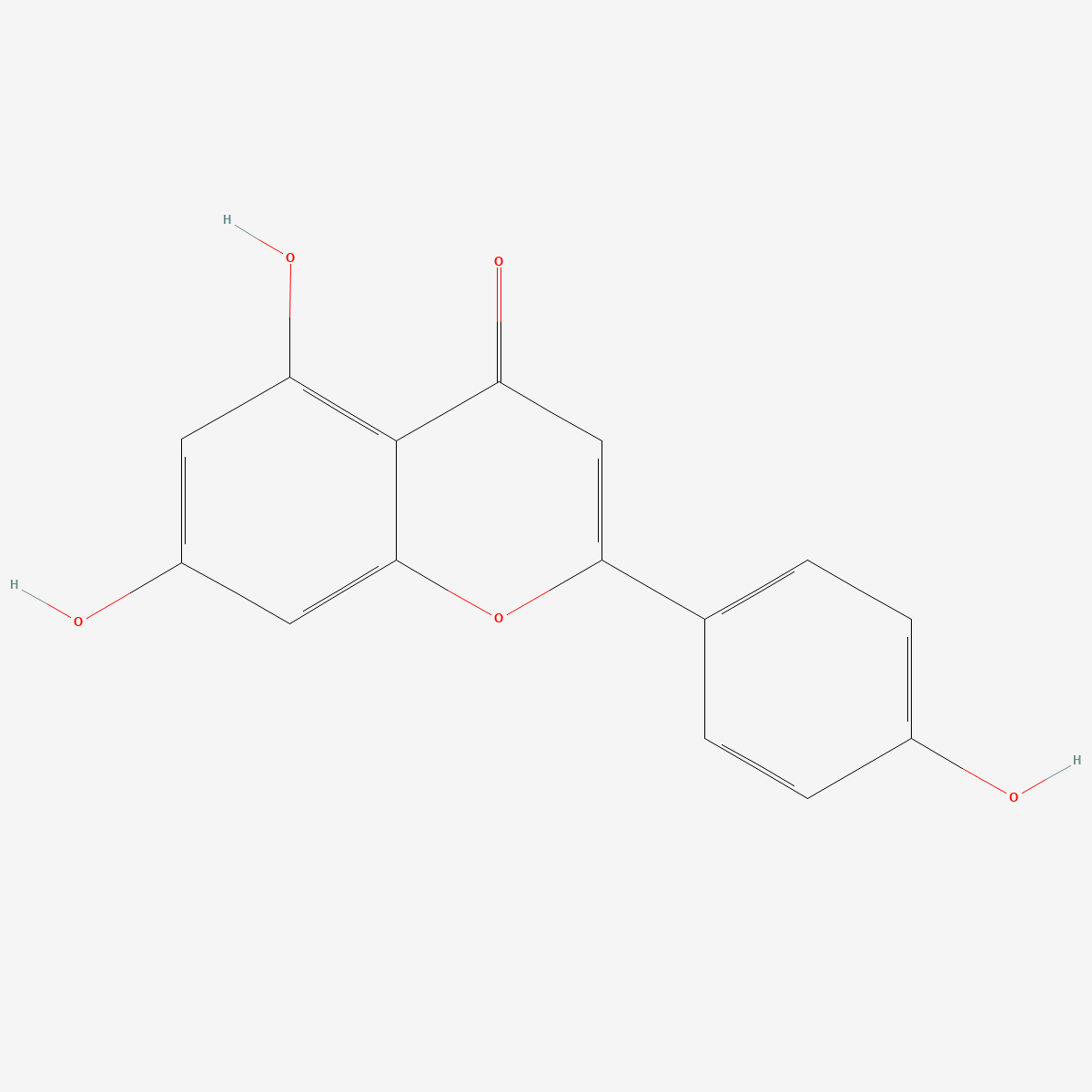
- Structure: apigenin is 5,7,4′-trihydroxyflavone (CAS 520-36-5, C15H10O5, MW 270.24) — a flavone with three phenolic hydroxyls and no sugar attached, distinguishing it from its glycosides apiin and apigenin-7-O-glucoside.
- Binding: competitive inhibition of flunitrazepam binding with a Ki of 4 µM, with no effect on muscarinic receptors, α1-adrenoceptors, or muscimol binding to GABAA receptors.[1]
- Function: at recombinant human α1β2γ2L receptors apigenin inhibited activation by GABA with an IC50 of 8 µM, and it also antagonised GABA at flumazenil-insensitive α1β2 receptors — which rules out the benzodiazepine site as the route for that effect.[2]
- A second target: NMDA receptor-mediated responses were reduced with an IC50 of 10 µM, while AMPA-mediated currents were almost unaffected.[3]
- Exposure limit: in humans the aglycone is poorly absorbed — metabolites equivalent to 0.5% of intake were excreted in urine over 0–24 h after apigenin itself, and the circulating species are glucuronides and a sulfate, not free apigenin.[7]
- Status: supplied as a reference standard for laboratory research. Not a medicine, not a supplement, and not for human or animal consumption.
The binding result that started it
Fractionation of an aqueous extract of Matricaria recutita flower heads, guided by affinity for the central benzodiazepine receptor, led to the isolation of apigenin. It competitively inhibited flunitrazepam binding with a Ki of 4 µM and was inactive at muscarinic receptors, at α1-adrenoceptors and against muscimol binding — a clean selectivity profile for a plant flavone. In mice it produced anxiolytic activity in the elevated plus maze at doses comparable to those used for classical benzodiazepines, without sedation or muscle relaxation; a ten-fold higher dose produced mild sedation, reported as a 26% reduction in ambulatory locomotor activity and a 35% decrement in hole-board parameters. No anticonvulsant action was detected.[1]
That last clause is worth pausing on. A full positive allosteric modulator at the benzodiazepine site would be expected to raise seizure thresholds. Its absence was an early hint that the binding and the behaviour were not connected in the obvious way.
What happened when the current was recorded
Two 2004 papers, published within days of each other and using different preparations, both found apigenin to be a GABAA antagonist. In Xenopus laevis oocytes expressing recombinant human α1β2γ2L receptors, apigenin inhibited activation by 40 µM GABA with an IC50 of 8 µM, alongside genistein at 30 µM and (−)-epigallocatechin gallate at 15 µM. Decisively, apigenin and genistein also antagonised GABA at flumazenil-insensitive α1β2 receptors, which lack the γ subunit required for a benzodiazepine site — so the antagonism cannot be explained as negative modulation through that site.[2]
Patch-clamp work in the same year reached the same conclusion by another route. Apigenin reversibly reduced GABA-evoked currents mediated by α1β2γ2 receptors expressed in HEK293 cells, and decreased both the amplitude and the frequency of spontaneous inhibitory postsynaptic currents in cultured cortical neurons. The same study found the flavone almost inactive on AMPA-mediated currents but inhibitory at NMDA receptors with an IC50 of 10 µM, and neuroprotective against glutamate-induced toxicity in cerebellar and cortical cultures. The authors stated the tension plainly: inhibition of the GABA receptor cannot explain the drug’s in vivo effects, and the NMDA data reveal a different target, with a reduction in overall network excitability as the more plausible account of the sedative phenotype.[3]
A second-order effect on diazepam is not a first-order effect on GABA
The same oocyte study reported something subtler that is frequently misquoted as potentiation. Apigenin at 1 µM enhanced the modulatory action of 3 µM diazepam on activation by 5 µM GABA by up to 22%, and EGCG at 0.1 µM did so by up to 52%. This effect was not seen with genistein, and it did not extend to enhancement by allopregnanolone or by pentobarbitone.[2]
The structure of that claim matters. Apigenin modulated the modulator — a second-order action conditional on a benzodiazepine already being present — while its first-order action on GABA activation was inhibitory. Reporting this as “apigenin potentiates GABAA receptors” inverts the finding. In a preparation without an exogenous benzodiazepine, the measured direction is the opposite one.
The presynaptic account
A later study moved the question upstream of the receptor. In rat hippocampal nerve terminals, apigenin inhibited glutamate release and the rise in cytosolic free Ca2+ evoked by 4-aminopyridine, while having no effect on 4-aminopyridine-mediated depolarisation or Na+ influx — so the target is downstream of depolarisation. Chelating extracellular Ca2+ prevented the inhibition, as did blocking Cav2.2 (N-type) and Cav2.1 (P/Q-type) channel activity.[4]
Read alongside the NMDA data, this gives a coherent alternative mechanism for reduced excitability that does not require any GABAergic potentiation at all: less glutamate released, and less postsynaptic response to what is released. Whether this is the mechanism behind the behavioural effects reported in 1995 has not been demonstrated directly, and should not be asserted as though it had.
Away from the synapse: NF-κB and the inflammasome
The anti-inflammatory literature on apigenin is larger than the neuropharmacological one and is mechanistically better resolved. In LPS-stimulated human monocytes and mouse macrophages, apigenin inhibited production of IL-1β, IL-8 and TNF, and did so even when administered after LPS stimulation. Electrophoretic mobility shift assays showed it did not alter NF-κB–DNA binding, and classical proteasome-dependent degradation of IκBα still occurred; instead the effect tracked hypophosphorylation of Ser536 in the p65 subunit and inactivation of the IKK complex, an effect overcome by overexpressing IKKβ. Apigenin also reduced LPS-induced TNF and mortality from lethal LPS doses in vivo.[5]
Independent work in THP-1-derived and J774A.1 macrophages added two further routes: inhibition of LPS-induced IL-1β production by blocking caspase-1 activation through disruption of NLRP3 inflammasome assembly, and reduction of IL-6 and IL-1β by decreasing mRNA stability via inhibition of ERK1/2 activation.[6] “Multiple mechanisms” is the accurate description here, and it is a warning as much as a finding: a compound that touches this many nodes at similar concentrations is difficult to use as a selective pharmacological tool.
The exposure problem that governs interpretation
Almost every mechanistic result above was obtained at free aglycone concentrations of roughly 1–10 µM. Human absorption work shows why that matters. Apigenin per se was poorly absorbed, with metabolites equivalent to only 0.5% of intake excreted in urine over 0–24 h. The identified circulating metabolites were apigenin-4′-glucuronide, apigenin-7-glucuronide and apigenin-7-sulfate — conjugates, not the aglycone. Route and matrix changed the kinetics substantially: a parsley drink gave a Cmax of apigenin-4′-glucuronide at 4 h with urinary excretion equal to 11.2% of intake; dried parsley leaves with yogurt extended that Cmax to 6 h; chamomile tea gave a 2 h Cmax and urinary excretion equal to 34% of intake.[7]
Rodent work by a different route tells a different story again. After intraperitoneal administration in mice, elimination from serum was very slow and elimination from brain slower still, so the authors expected relatively high brain accumulation. In the same study, acute apigenin at 100 and 150 mg/kg raised thresholds for the myoclonic twitch in the intravenous pentylenetetrazole test, for 6 Hz-induced seizure and for hindlimb tonus in the maximal electroshock test, and 14-day treatment at 50 mg/kg raised the maximal electroshock threshold; repeated dosing increased the mean number of GABAA receptor- and parvalbumin-immunoreactive neurons in hippocampal fields. The authors’ own summary was restrained — a relatively minor effect on acute seizures.[8] Note the contrast with the 1995 report, which found no anticonvulsant action at all; route, dose and species differ, and the disagreement has not been resolved.
Practical notes for laboratory handling
Apigenin is poorly soluble in water and is normally handled as a DMSO stock. Three phenolic hydroxyls make it susceptible to oxidation and to pH-dependent colour change, so buffers should be freshly prepared and solutions protected from light. Most importantly for reproducibility, the aglycone and its glycosides are not interchangeable: apiin and apigenin-7-O-glucoside carry different molecular masses and different absorption behaviour, and a protocol that specifies “apigenin” without specifying the form is under-determined.
Frequently asked questions
Does apigenin act like a benzodiazepine?
Not functionally. It competes with flunitrazepam for binding,[1] but in two independent electrophysiological studies it reduced GABA-evoked currents rather than enhancing them, including at γ-subunit-free receptors that have no benzodiazepine site.[2][3] Binding at a site and modulating positively through it are different claims, and only the first is supported.
Why do in vitro results not translate straightforwardly to whole-animal studies?
Chiefly because the species that circulates is not the species that was tested. Human absorption work identified glucuronide and sulfate conjugates as the in vivo metabolites, with free aglycone poorly absorbed.[7] An IC50 of 8–10 µM for free apigenin therefore cannot be compared directly with an oral intake without an argument about deconjugation.
Is the anti-inflammatory evidence stronger than the neurological evidence?
Mechanistically, yes. The NF-κB work identifies a specific step — p65 Ser536 phosphorylation and IKK inactivation — and includes a rescue experiment by IKKβ overexpression,[5] with separate work adding NLRP3 inflammasome and ERK1/2-dependent mRNA stability routes.[6] That is a higher standard of evidence than the GABAA literature currently reaches.
What should an apigenin reference standard be characterised for?
Assay purity, explicit aglycone-versus-glycoside identity, and absence of closely related flavones such as luteolin, which differs by a single hydroxyl and co-elutes under short gradients. Our apigenin reference standard (CAS 520-36-5) is supplied as the aglycone with identity documentation available on request.
Related compounds in our catalogue
Researchers comparing compounds with reported anxiolytic profiles but unrelated molecular targets often work alongside mebicar reference material (CAS 10095-06-4), a bicyclic urea derivative studied outside the benzodiazepine framework entirely, and bromantane (CAS 87913-26-6), whose reported mechanism runs through enzyme expression rather than through ionotropic receptors.
References
- Viola H, Wasowski C, Levi de Stein M, Wolfman C, Silveira R, Dajas F, Medina JH, Paladini AC. Apigenin, a component of Matricaria recutita flowers, is a central benzodiazepine receptors-ligand with anxiolytic effects. Planta Medica. 1995;61(3):213–216. doi:10.1055/s-2006-958058 · PMID: 7617761
- Campbell EL, Chebib M, Johnston GA. The dietary flavonoids apigenin and (-)-epigallocatechin gallate enhance the positive modulation by diazepam of the activation by GABA of recombinant GABA(A) receptors. Biochemical Pharmacology. 2004;68(8):1631–1638. doi:10.1016/j.bcp.2004.07.022 · PMID: 15451406
- Losi G, Puia G, Garzon G, de Vuono MC, Baraldi M. Apigenin modulates GABAergic and glutamatergic transmission in cultured cortical neurons. European Journal of Pharmacology. 2004;502(1-2):41–46. doi:10.1016/j.ejphar.2004.08.043 · PMID: 15464088
- Chang CY, Lin TY, Lu CW, Wang CC, Wang YC, Chou SS, Wang SJ. Apigenin, a natural flavonoid, inhibits glutamate release in the rat hippocampus. European Journal of Pharmacology. 2015;762:72–81. doi:10.1016/j.ejphar.2015.05.035 · PMID: 26007643
- Nicholas C, Batra S, Vargo MA, Voss OH, Gavrilin MA, Wewers MD, Guttridge DC, Grotewold E, Doseff AI. Apigenin blocks lipopolysaccharide-induced lethality in vivo and proinflammatory cytokines expression by inactivating NF-kappaB through the suppression of p65 phosphorylation. Journal of Immunology. 2007;179(10):7121–7127. doi:10.4049/jimmunol.179.10.7121 · PMID: 17982104
- Zhang X, Wang G, Gurley EC, Zhou H. Flavonoid apigenin inhibits lipopolysaccharide-induced inflammatory response through multiple mechanisms in macrophages. PLoS One. 2014;9(9):e107072. doi:10.1371/journal.pone.0107072 · PMID: 25192391
- Borges G, Fong RY, Ensunsa JL, Kimball J, Medici V, Ottaviani JI, Crozier A. Absorption, distribution, metabolism and excretion of apigenin and its glycosides in healthy male adults. Free Radical Biology and Medicine. 2022;185:90–96. doi:10.1016/j.freeradbiomed.2022.04.007 · PMID: 35452808
- Socała K, Kowalczuk-Vasilev E, Komar M, Szalak R, Wyska E, Wlaź P. Effect of apigenin on seizure susceptibility, parvalbumin immunoreactivity, and GABA(A) receptor expression in the hippocampal neurons in mice. European Journal of Pharmacology. 2025;996:177548. doi:10.1016/j.ejphar.2025.177548 · PMID: 40157704
Research use only. The compounds discussed are supplied as reference standards for laboratory research. They are not medicines, not dietary supplements, and are not for human or animal consumption. Nothing in this article is medical advice or a recommendation for use in humans. Any quantities mentioned are those reported in the published studies cited above and appear solely to describe that research accurately.