Phosphodiesterase type 5 inhibitors are usually presented as one class whose members differ only in how long they last. The primary literature says something more specific about tadalafil. Its scaffold is unrelated to that of sildenafil and vardenafil, and the difference shows up as an inverted selectivity profile: tadalafil spares the retinal enzyme PDE6 that troubles the first-generation compounds, while potently inhibiting PDE11, an isoenzyme whose physiological role was described as unknown when that comparison was published. This is a summary of what has actually been measured — and of which numbers depend on the assay rather than on the molecule.
Key points
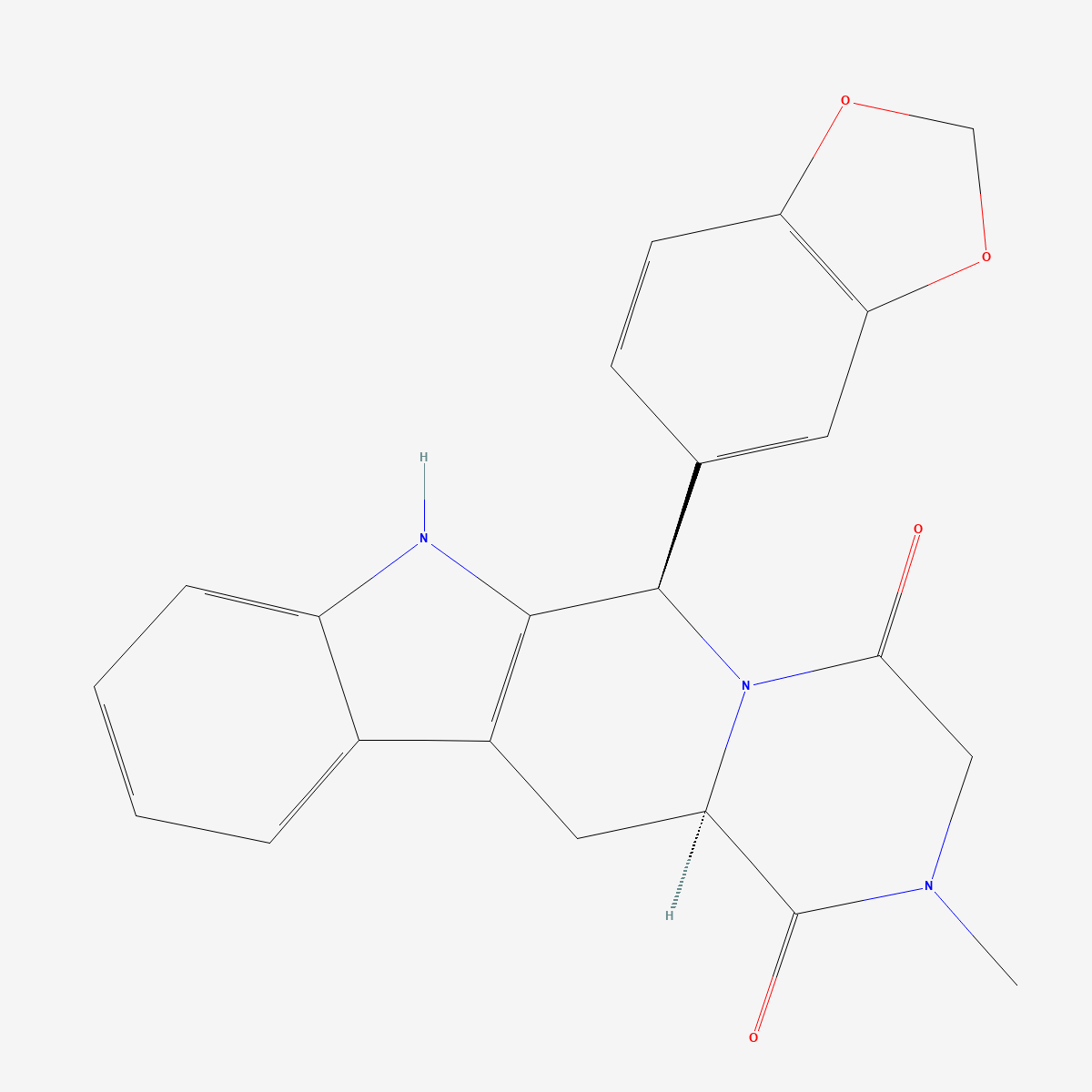
- Structure: tadalafil is a rigid tetracyclic β-carboline-derived diketopiperazine (CAS 171596-29-5, C22H19N3O4, MW 389.4), chemically unrelated to the pyrazolopyrimidinone core shared by sildenafil and vardenafil.
- Primary target: competitive inhibition at the catalytic site of PDE5, the phosphodiesterase that hydrolyses cGMP. The effect is amplification of an existing nitric oxide signal, not generation of a new one — without upstream NO–guanylate cyclase activity there is little cGMP to preserve.
- Selectivity trade: reported as extremely selective for PDE5 against PDE1 and PDE6, but a potent inhibitor of PDE11 — the reverse of the sildenafil and vardenafil pattern.[1]
- Exposure profile: mean terminal half-life 17.5 h (5th–95th percentiles 11.5–29.6 h) across 237 healthy subjects, steady state by day 5 of once-daily dosing, negligible food effect.[4]
- Evidence beyond erectile tissue: a 405-patient randomised trial in pulmonary arterial hypertension, crossover work in dystrophic human muscle, and rodent myocardial ischaemia models.[5][6][8]
- Status: supplied as a reference standard for laboratory research. Not a medicine, not a supplement, and not for human or animal consumption.
What PDE5 inhibition does to a signalling pathway
The nitric oxide pathway runs NO → soluble guanylate cyclase → cGMP → protein kinase G, and PDE5 is the enzyme that terminates it by hydrolysing cGMP. An inhibitor at the catalytic site therefore does not initiate signalling; it extends the lifetime of cGMP that upstream machinery has already produced. The PHIRST investigators put this plainly when they described tadalafil as increasing cGMP, the final mediator in the nitric oxide pathway.[5] The consequence for assay design is that a preparation with little tonic NO production will show a small response to a PDE5 inhibitor, and that the size of the response is a property of the preparation as much as of the compound.
The catalytic pocket itself is not a rigid slot. Crystallographic work on the fully active catalytic domain of PDE5A1 — solved unliganded and in complex with sildenafil and with icarisid II — showed that the H-loop spanning residues 660–683 adopts four different conformations and migrates 7–35 Å on inhibitor binding.[2] That plasticity is the structural reason why chemically unrelated molecules can all occupy the same site with high affinity, and why docking results for this enzyme are sensitive to which conformation was used as the template.
Selectivity is a profile across eleven families, not a single number
A comparative review of PDE inhibitor potency and selectivity reported that sildenafil, vardenafil and tadalafil are all selective for PDE5, but that the residual activity falls on different isoenzymes. Against PDE1 — expressed in brain, myocardium and vascular smooth muscle — the selectivity ranking was tadalafil > vardenafil > sildenafil. Against PDE6, the retinal enzyme of visual transduction whose inhibition can transiently disturb vision, the ranking was again tadalafil > vardenafil ≈ sildenafil. The same review noted that tadalafil, while extremely selective for PDE5 on those axes, potently inhibits PDE11, characterised there as an enzyme of unknown physiological function.[1]
That last point has been a target of subsequent medicinal chemistry rather than a settled question. A modelling and virtual-screening study framed cross-reactivity with PDE6 and PDE11 as the central design problem for new PDE5 inhibitors, on the grounds that the catalytic domains of the three enzymes are similar in sequence and secondary structure; the same paper noted that tadalafil blocks hERG1 potassium channels in a concentration-dependent manner and screened its candidate hits for predicted cardiotoxicity.[9] This work is computational. It generates hypotheses about selectivity rather than measurements of it, and should be read that way.
The PDE11 number depends on which splice variant was assayed
There is a specific and often-overlooked reason to distrust any single PDE11 potency figure. The PDE11A family comprises four splice variants sharing a conserved C-terminal catalytic domain, with N-termini that differ in length and sequence. Direct comparison showed that PDE11A1 and PDE11A2 have higher affinity for both cAMP and cGMP than the longest isoform, PDE11A4, and — crucially for anyone quoting an inhibition constant — that PDE11A3, PDE11A2 and PDE11A1, which have progressively shorter N-termini, were more sensitive than PDE11A4 to inhibition by two structurally unrelated inhibitors, tadalafil and vardenafil.[3]
The authors attributed this to the N-terminal region itself lowering the affinity of the catalytic domain for substrates and inhibitors, and ruled out an explanation based on quaternary structure, since PDE11A4, A3 and A2 were dimers while A1 was a tetramer. A reported tadalafil–PDE11 potency is therefore incomplete without the isoform. Comparisons drawn between papers that assayed different variants are not comparisons of the same quantity.
Why the exposure profile shapes experimental design
An integrated analysis of 13 clinical pharmacology studies characterised single- and multiple-dose plasma pharmacokinetics in healthy subjects. Absorption was rapid, with a mean Cmax of 378 µg/l for a 20 mg dose reached at 2 h, followed by a nearly monoexponential decline with a mean terminal half-life of 17.5 h. Mean oral clearance was 2.48 l/h and apparent volume of distribution 62.6 l. Exposure was proportional to dose, unaffected by time of dosing or by food, and steady state was attained by day 5 of once-daily administration with 1.6-fold accumulation consistent with the half-life. The authors concluded that systemic clearance is low relative to other PDE5 inhibitors.[4]
Two design consequences follow. First, once-daily administration of this compound produces a relatively flat exposure profile rather than a pulse, so any study attributing an effect to peak concentration needs to justify that attribution. Second, washout between crossover arms has to be scaled to a half-life that runs to nearly 30 h at the upper reported percentile, not to the mean.
What has been measured outside erectile tissue
The largest controlled dataset is PHIRST, a 16-week double-blind placebo-controlled study in 405 patients with idiopathic or associated pulmonary arterial hypertension, either treatment-naive or on background bosentan, randomised to placebo or 2.5, 10, 20 or 40 mg once daily. Six-minute walk distance increased dose-dependently, but only the 40 mg arm met the prespecified level of statistical significance. The mean placebo-corrected treatment effect was 33 m (95% CI 15 to 50 m); in the bosentan-naive subgroup it was 44 m (95% CI 20 to 69 m) against 23 m (95% CI −2 to 48 m) in patients already on bosentan. Time to clinical worsening improved (P = 0.041), while changes in WHO functional class were not statistically significant.[5] The honest reading is a modest, dose-dependent effect that attenuates on background therapy.
A separate line of work used dystrophic muscle as a mechanistic probe. In Becker muscular dystrophy, the most common dystrophin mutations disrupt sarcolemmal targeting of neuronal nitric oxide synthase (nNOSμ), which normally attenuates local α-adrenergic vasoconstriction during exercise. In a randomised placebo-controlled crossover trial, a single dose of tadalafil alleviated functional muscle ischaemia and restored normal blood-flow regulation in affected men — an unusually direct demonstration that the compound acts by boosting NO–cGMP signalling rather than independently of it.[6] A follow-up study in 10 boys with Duchenne muscular dystrophy and 10 age-matched male controls reported the same relief of functional muscle ischaemia with single oral doses of either tadalafil or sildenafil, and also normalised the blunted exercise-induced increase in skeletal muscle blood flow measured by Doppler ultrasound. That study was open-label and dose-escalating, and its authors graded it as Class IV evidence.[7]
In rodent myocardium, treatment of type 2 diabetic db/db mice with tadalafil at 1 mg/kg intraperitoneally for 28 days reduced infarct size after 30 min global ischaemia and 60 min reperfusion in the Langendorff mode (21.2 ± 1.8% versus 45.8 ± 2.8%, p < 0.01), alongside suppressed reactive oxygen species production and attenuated myocardial expression of pRac1 and gp91phox.[8] This is a disease-model result in a strain with impaired NO bioavailability, and it does not generalise automatically to healthy myocardium.
Practical notes for laboratory handling
Tadalafil has poor aqueous solubility, and stock solutions are ordinarily prepared in DMSO. The rigid tetracyclic framework makes the molecule conformationally well defined, which is convenient for chromatographic identity work, while the two amide carbonyls of the diketopiperazine ring are the obvious handles to watch under strongly acidic or basic hydrolytic conditions. As with any reference standard, identity and assay should be verified by spectroscopic and chromatographic methods rather than inferred from the label.
Frequently asked questions
Is tadalafil more selective than sildenafil?
Against some isoenzymes, yes; against others, no. The published comparison ranks tadalafil ahead of both sildenafil and vardenafil for selectivity against PDE1 and PDE6, but identifies it as a potent PDE11 inhibitor while the first-generation compounds are not.[1] “More selective” is not a property a PDE inhibitor has in the abstract; it is a statement about a named off-target.
Why is tadalafil’s duration of action so much longer?
Because its clearance is low. The integrated pharmacokinetic analysis gives a mean oral clearance of 2.48 l/h and a mean terminal half-life of 17.5 h, and the authors explicitly note that systemic clearance is low relative to other PDE5 inhibitors.[4] Duration here is a disposition property, not a difference in how tightly the enzyme is bound.
Does PDE11 inhibition have known consequences?
Not established ones. The review that flagged tadalafil’s PDE11 potency described the enzyme’s physiological function as unknown.[1] Since then the main methodological finding has been that measured sensitivity to tadalafil differs between PDE11A splice variants,[3] which complicates the interpretation of any single reported potency rather than resolving the physiology.
What purity should a tadalafil reference standard have for analytical work?
For quantitative work the practical minimum is material characterised at ≥99% with a stated assay method, because impurities in this compound class can be structurally close analogues that co-elute under short chromatographic methods. Our tadalafil reference standard, assayed at ≥99% purity (CAS 171596-29-5) is supplied with identity documentation available on request.
Related compounds in our catalogue
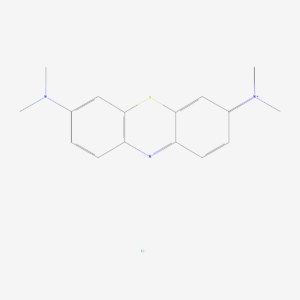
Researchers assembling a panel around the nitric oxide–cGMP axis frequently work alongside methylene blue reference material (CAS 61-73-4), which acts on soluble guanylate cyclase upstream of the phosphodiesterase step rather than on cGMP breakdown, and apigenin (CAS 520-36-5), a flavone used as a comparator compound in intracellular signalling and kinase assays.
References
- Bischoff E. Potency, selectivity, and consequences of nonselectivity of PDE inhibition. International Journal of Impotence Research. 2004;16(Suppl 1):S11–S14. doi:10.1038/sj.ijir.3901208 · PMID: 15224129
- Wang H, Liu Y, Huai Q, Cai J, Zoraghi R, Francis SH, Corbin JD, Robinson H, Xin Z, Lin G, Ke H. Multiple conformations of phosphodiesterase-5: implications for enzyme function and drug development. Journal of Biological Chemistry. 2006;281(30):21469–21479. doi:10.1074/jbc.M512527200 · PMID: 16735511
- Weeks JL 2nd, Zoraghi R, Francis SH, Corbin JD. N-Terminal domain of phosphodiesterase-11A4 (PDE11A4) decreases affinity of the catalytic site for substrates and tadalafil, and is involved in oligomerization. Biochemistry. 2007;46(36):10353–10364. doi:10.1021/bi7009629 · PMID: 17696499
- Forgue ST, Patterson BE, Bedding AW, Payne CD, Phillips DL, Wrishko RE, Mitchell MI. Tadalafil pharmacokinetics in healthy subjects. British Journal of Clinical Pharmacology. 2006;61(3):280–288. doi:10.1111/j.1365-2125.2005.02553.x · PMID: 16487221
- Galiè N, Brundage BH, Ghofrani HA, Oudiz RJ, Simonneau G, Safdar Z, Shapiro S, White RJ, Chan M, Beardsworth A, Frumkin L, Barst RJ. Tadalafil therapy for pulmonary arterial hypertension. Circulation. 2009;119(22):2894–2903. doi:10.1161/CIRCULATIONAHA.108.839274 · PMID: 19470885
- Martin EA, Barresi R, Byrne BJ, Tsimerinov EI, Scott BL, Walker AE, Gurudevan SV, Anene F, Elashoff RM, Thomas GD, Victor RG. Tadalafil alleviates muscle ischemia in patients with Becker muscular dystrophy. Science Translational Medicine. 2012;4(162):162ra155. doi:10.1126/scitranslmed.3004327 · PMID: 23197572
- Nelson MD, Rader F, Tang X, Tavyev J, Nelson SF, Miceli MC, Elashoff RM, Sweeney HL, Victor RG. PDE5 inhibition alleviates functional muscle ischemia in boys with Duchenne muscular dystrophy. Neurology. 2014;82(23):2085–2091. doi:10.1212/WNL.0000000000000498 · PMID: 24808022
- Koka S, Das A, Salloum FN, Kukreja RC. Phosphodiesterase-5 inhibitor tadalafil attenuates oxidative stress and protects against myocardial ischemia/reperfusion injury in type 2 diabetic mice. Free Radical Biology and Medicine. 2013;60:80–88. doi:10.1016/j.freeradbiomed.2013.01.031 · PMID: 23385031
- Kayık G, Tüzün NŞ, Durdagi S. Investigation of PDE5/PDE6 and PDE5/PDE11 selective potent tadalafil-like PDE5 inhibitors using combination of molecular modeling approaches, molecular fingerprint-based virtual screening protocols and structure-based pharmacophore development. Journal of Enzyme Inhibition and Medicinal Chemistry. 2017;32(1):311–330. doi:10.1080/14756366.2016.1250756 · PMID: 28150511
Research use only. The compounds discussed are supplied as reference standards for laboratory research. They are not medicines, not dietary supplements, and are not for human or animal consumption. Nothing in this article is medical advice or a recommendation for use in humans. Any quantities mentioned are those reported in the published studies cited above and appear solely to describe that research accurately.