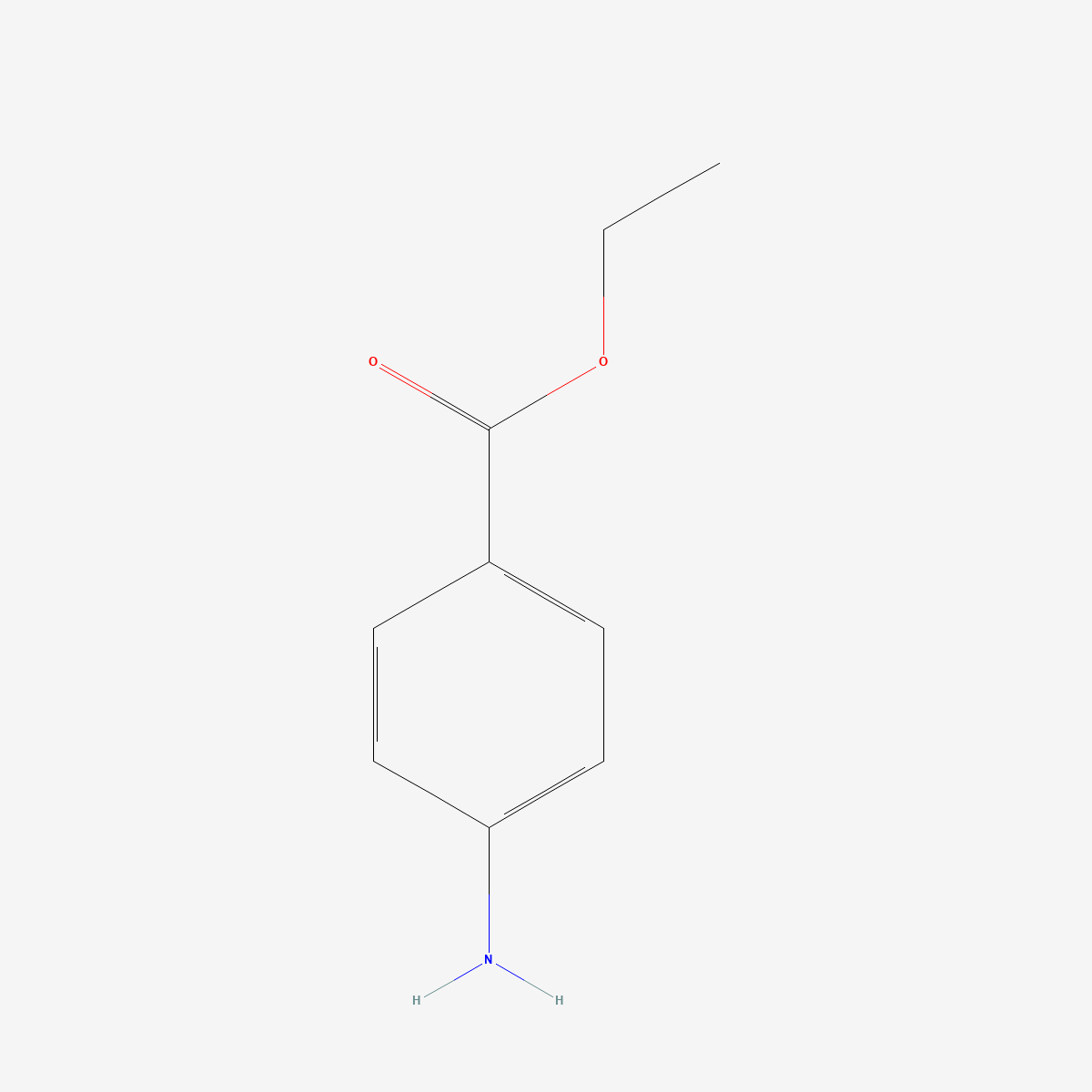
Benzocaine has no basic side chain. Strip the diethylaminoethyl tail off procaine and you are left with ethyl 4-aminobenzoate — the same aromatic ester, minus the one feature that lets every clinically familiar local anaesthetic carry a positive charge at physiological pH. That single omission turned benzocaine into the reference compound of an argument that has run since the 1970s: how does a molecule that cannot enter through the open channel mouth still block the sodium channel? The answer has shaped how the whole class is understood.
Key points
- Structure: ethyl 4-aminobenzoate (CAS 94-09-7, C9H11NO2, MW 165.19) — the para-aminobenzoate ester without an ionisable aliphatic amine, and classified in the electrophysiological literature as a neutral local anaesthetic.[2]
- Two access pathways: Hille’s model assigns lipid-soluble neutral forms a hydrophobic route through the membrane and charged forms a hydrophilic route through the inner channel mouth, which is open only when the channel gates are open.[2]
- Use-dependence: essentially absent. At concentrations producing matched tonic block, 1 Hz stimulation gave tocainide about 75% phasic block of the remaining channels while benzocaine showed little such effect.[4]
- Where it binds: molecular dynamics on the bacterial channel NavAb places benzocaine at two hydrophobic sites — just above the activation gate and at the entrance to the lateral lipid-filled fenestrations, which it can cross with only small energy barriers.[6]
- Oxidative hazard: a survey of 242 published episodes of local-anaesthetic-related methaemoglobinaemia concluded that a single spray of benzocaine may induce it, with rebound up to 18 hours after methylene blue.[7]
- Status: supplied as a reference standard for laboratory research. Not a medicine and not for human or animal consumption.
An ester with no base
Benzocaine belongs to the amino ester series that replaced cocaine after the toxicity of the natural alkaloid became apparent. The historical account places it among the amino esters synthesised between 1891 and 1930, alongside tropocaine, eucaine, holocaine, orthoform and tetracaine, all of them developed because local anaesthesia was in crisis and cocaine was killing patients and medical staff alike.[1]
What distinguishes benzocaine inside that series is what it lacks. Procaine, tetracaine and the later amides all carry a tertiary aliphatic amine on a side chain, and that amine is substantially protonated at pH 7.4. Benzocaine’s only nitrogen is the aromatic amine on the ring, which is a far weaker base — an anilinic nitrogen with its lone pair delocalised into the ring. The consequence is that benzocaine exists in solution at physiological pH essentially as a single, uncharged species. In the voltage-clamp literature this is not an inference but a working classification: Hille’s foundational study explicitly separates “neutral, amine, and quaternary” local anaesthetic compounds, with benzocaine as the neutral representative and lidocaine and tetracaine as the ionisable amines.[2] The charged sibling of this molecule is treated separately in our note on procaine hydrochloride, the cation with a built-in off switch.
Two pathways, one receptor
Hille studied sodium channels at the node of Ranvier and found that conventional steady-state inactivation measurements using 50 ms prepulses produced a large negative shift of the inactivation curve with neutral benzocaine and with ionisable amines such as lidocaine and tetracaine — but no shift at all with the permanently charged quaternary compound QX-572. When the same experiment was repeated with repetitive prepulse–testpulse waveforms, the quaternary cation applied internally also produced a shift. One-minute hyperpolarisations of lidocaine- or tetracaine-treated fibres restored two to four times as many channels to the conducting pool as 50 ms hyperpolarisations did, and raising external calcium had a strong unblocking effect; neither manipulation relieved block by internal quaternary drugs.[2]
The interpretation was a single receptor in the sodium channel serving several drug types, approached by two different routes. Lipid-soluble forms come and go through a hydrophobic region of the membrane; charged and less lipid-soluble forms pass through a hydrophilic region, the inner channel mouth, which is accessible only while the gates are open. Any drug form occupying the receptor increases the probability of closing the inactivation gate, which appears experimentally as a negative shift in the voltage dependence of inactivation.[2] Benzocaine is what the hydrophobic half of that model was built on.
The complication nobody has fully resolved
Four years later, Huang and Ehrenstein studied batrachotoxin-activated sodium channels in mouse neuroblastoma N18 cells and compared benzocaine with the permanently charged QX-572. Dose-response curves for each drug suggested a single class of binding sites, with dissociation constants of 3.15 × 10⁻⁵ M for QX-572 and 2.65 × 10⁻⁴ M for benzocaine. Both drugs behaved as competitive inhibitors of batrachotoxin. But when benzocaine and QX-572 were present together with batrachotoxin, the inhibition of sodium flux was much greater than a one-site model predicts, which the authors read as evidence that the two drugs occupy separate sites, each interacting competitively with batrachotoxin.[3]
These two pictures — one receptor with two access routes, versus two distinct sites — have never been cleanly reconciled, and it is worth stating that rather than smoothing it over. Part of the discrepancy is almost certainly the preparation: a batrachotoxin-activated channel is a channel locked open and heavily modified, not a resting one.
What structural and mutational work added
Hanck and colleagues used gating currents and concentration-dependent availability curves in the cardiac channel NaV1.5 to examine the role of Phe1759, a phenylalanine in domain IV S6 modelled to face the inner pore just below the selectivity filter and known to be critical in use-dependent block. Replacing Phe1759 with a non-aromatic residue split the action of both lidocaine and benzocaine into two separable components: a voltage-independent, low-affinity block of closed channels, which they designated lipophilic block, and a high-affinity, voltage-dependent block of open and inactivated channels linked to stabilisation of the S4 segments in domains III and IV, designated voltage-sensor inhibition.[5] Benzocaine, in that framework, is dominated by the first component. That is not a quirk of the molecule; it is the structural translation of having no charge.
Martin and Corry then ran molecular dynamics on the bacterial channel NavAb and located benzocaine and phenytoin at two likely pore sites, both characterised by non-specific hydrophobic interactions: one just above the activation gate and one at the entrance to the lateral lipid-filled fenestrations. Three independent methods agreed on the same sites, all of them finding binding at the activation gate slightly more favourable. Crucially, both drugs were able to pass through the fenestrations into the lipid with only small energy barriers — which the authors put forward as the long-posited hydrophobic entrance route for neutral drugs.[6] Thirty-seven years after Hille proposed a membrane route on kinetic grounds, a simulation showed a plausible physical door.
Why benzocaine barely shows use-dependence
DeLuca and colleagues made the comparison explicit in voltage-clamped human myoballs. Concentrations were chosen so that without stimulation, at a holding potential of −135 mV, either 0.5 mM tocainide or 1 mM benzocaine blocked about 50% of channels. With repetitive stimulation at 1 Hz, tocainide went on to block roughly 75% of the channels that had remained available in the rested state, while benzocaine had little such effect. The two drugs also differed in which inactivated state they recognise: benzocaine shifted the steady-state inactivation curve leftward whether the conditioning pulse was 8 ms or 512 ms, indicating that it binds the fast-inactivated state, whereas tocainide shifted the curve only with long prepulses, that is, only with channels in intermediate inactivation. Recovery from inactivation, normally governed by two time constants, was markedly slowed by tocainide but not substantially modified by benzocaine.[4]
For anyone setting up a sodium-channel assay, this is what makes benzocaine useful: it is a tonic-block reference compound. It produces state-dependent block without the frequency dependence that complicates interpretation of every charged blocker, so it isolates one variable at a time.
Practical notes on handling and formulation
The absence of charge that makes benzocaine mechanistically interesting also makes it poorly water-soluble, and formulation work reflects that. A liposome-based benzocaine preparation characterised by membrane/water partition coefficient, encapsulation efficiency, size, polydispersity and zeta potential, then compared against plain and commercial gels in Franz-type diffusion cells through pig oesophageal mucosa, showed higher flux and retention with a shorter lag time; flux correlated strongly with in vivo anaesthetic efficacy in volunteers, while retention correlated with nothing.[8] Partitioning, not tissue loading, is the variable that tracks effect.
Two hazards are worth naming. The first is oxidation of the aromatic amine, which is the structural basis of benzocaine-associated methaemoglobinaemia; Guay’s survey of 242 published episodes found a discrepancy between pulse oximetry saturation and arterial oxygen partial pressure in 91.8% of cases, symptoms at relatively low methaemoglobin values, rebound methaemoglobinaemia after benzocaine on mucous membranes reaching values as high as 59.9% up to 18 hours after methylene blue administration, and complications including hypoxic encephalopathy, myocardial infarction and death. The review’s conclusion regarding clinical use was unambiguous.[7] Store protected from light and air, and treat exposure to oxidants as a degradation route. The second is that benzocaine’s biological effects are not confined to nerve block: in fat snook acclimated to different salinities, time under benzocaine anaesthesia had a strong positive relationship with plasma cortisol and glucose regardless of salinity, even though osmo-ionic balance was maintained.[9] Exposure duration is a variable in its own right.
Frequently asked questions
Is benzocaine the same kind of local anaesthetic as lidocaine?
Both act at the voltage-gated sodium channel, but they are not interchangeable experimentally. Lidocaine is an ionisable amine that can reach the binding site through the open channel mouth as a cation, and it shows pronounced use-dependent block. Benzocaine is neutral, reaches the site through the membrane, and shows almost none.[2][4] Benzocaine is also an ester, whereas lidocaine is an amide, which gives them entirely different metabolic fates.
Why doesn’t benzocaine show use-dependent block?
Use-dependence arises when a drug reaches its site preferentially through channels that are open, so that repeated opening accumulates block. A neutral molecule that partitions into the membrane and enters laterally through the fenestrations does not need the channel to open in order to reach the pore, so stimulation frequency has little influence on how much drug is bound.[4][6]
What is the structural reason for benzocaine-related methaemoglobinaemia?
The para-aminobenzoate ring carries an aromatic amine that is readily oxidised, and oxidising metabolites of aromatic amines convert haemoglobin iron from the ferrous to the ferric state. The published episode series documents the clinical consequences in detail, including the diagnostic gap between pulse oximetry and arterial blood gas measurement.[7]
What purity is appropriate for benzocaine used as a reference standard?
For electrophysiology and analytical work, material characterised at ≥99% with the assay method stated is the practical minimum, and a check for free para-aminobenzoic acid is worth making on older stock, since ester hydrolysis is the expected degradation route. Our benzocaine reference standard (CAS 94-09-7) ships with identity documentation available on request.
Related compounds in our catalogue
Laboratories building a comparison set for sodium-channel work usually pair benzocaine with procaine hydrochloride (CAS 51-05-8), the charged ester that takes the hydrophilic pathway, and lidocaine (CAS 137-58-6), the amide whose pronounced use-dependence makes it the standard positive control in frequency-dependent block experiments.
References
- Ruetsch YA, Böni T, Borgeat A. From cocaine to ropivacaine: the history of local anesthetic drugs. Current Topics in Medicinal Chemistry. 2001;1(3):175–182. doi:10.2174/1568026013395335
- Hille B. Local anesthetics: hydrophilic and hydrophobic pathways for the drug-receptor reaction. Journal of General Physiology. 1977;69(4):497–515. doi:10.1085/jgp.69.4.497
- Huang LM, Ehrenstein G. Local anesthetics QX 572 and benzocaine act at separate sites on the batrachotoxin-activated sodium channel. Journal of General Physiology. 1981;77(2):137–153. doi:10.1085/jgp.77.2.137
- DeLuca A, Pröbstle T, Brinkmeier H, Rüdel R. The different use dependences of tocainide and benzocaine are correlated with different effects on sodium channel inactivation. Naunyn-Schmiedeberg’s Archives of Pharmacology. 1991;344(5):596–601. doi:10.1007/BF00170658
- Hanck DA, Nikitina E, McNulty MM, Fozzard HA, Lipkind GM, Sheets MF. Using lidocaine and benzocaine to link sodium channel molecular conformations to state-dependent antiarrhythmic drug affinity. Circulation Research. 2009;105(5):492–499. doi:10.1161/CIRCRESAHA.109.198572
- Martin LJ, Corry B. Locating the route of entry and binding sites of benzocaine and phenytoin in a bacterial voltage gated sodium channel. PLoS Computational Biology. 2014;10(7):e1003688. doi:10.1371/journal.pcbi.1003688
- Guay J. Methemoglobinemia related to local anesthetics: a summary of 242 episodes. Anesthesia & Analgesia. 2009;108(3):837–845. doi:10.1213/ane.0b013e318187c4b1
- Franz-Montan M, Cereda CM, Gaspari A, da Silva CM, de Araújo DR, Padula C, Santi P, Narvaes E, Novaes PD, Groppo FC, de Paula E. Liposomal-benzocaine gel formulation: correlation between in vitro assays and in vivo topical anesthesia in volunteers. Journal of Liposome Research. 2013;23(1):54–60. doi:10.3109/08982104.2012.742536
- Wosnick N, Bendhack F, Leite RD, Morais RN, Freire CA. Benzocaine-induced stress in the euryhaline teleost, Centropomus parallelus and its implications for anesthesia protocols. Comparative Biochemistry and Physiology Part A: Molecular & Integrative Physiology. 2018;226:32–37. doi:10.1016/j.cbpa.2018.07.021
Research use only. The compounds discussed are supplied as reference standards for laboratory research. They are not medicines, not dietary supplements, and are not for human or animal consumption. Nothing in this article is medical advice or a recommendation for use in humans. Any quantities mentioned are those reported in the published studies cited above and appear solely to describe that research accurately.