A PubMed search across every name this compound travels under — flmodafinil, lauflumide, CRL-40,940, NLS-4, and the enantiopure codes JBG1-048 and JBG1-049 — returns five indexed papers that examine this exact chemical entity. One administered it to humans. Three used a single resolved enantiomer rather than the compound as it is normally supplied. One is analytical chemistry. That is the entire direct evidence base, and any account of how this molecule works is therefore part measurement and part extrapolation from modafinil. This article separates the two.
Key points
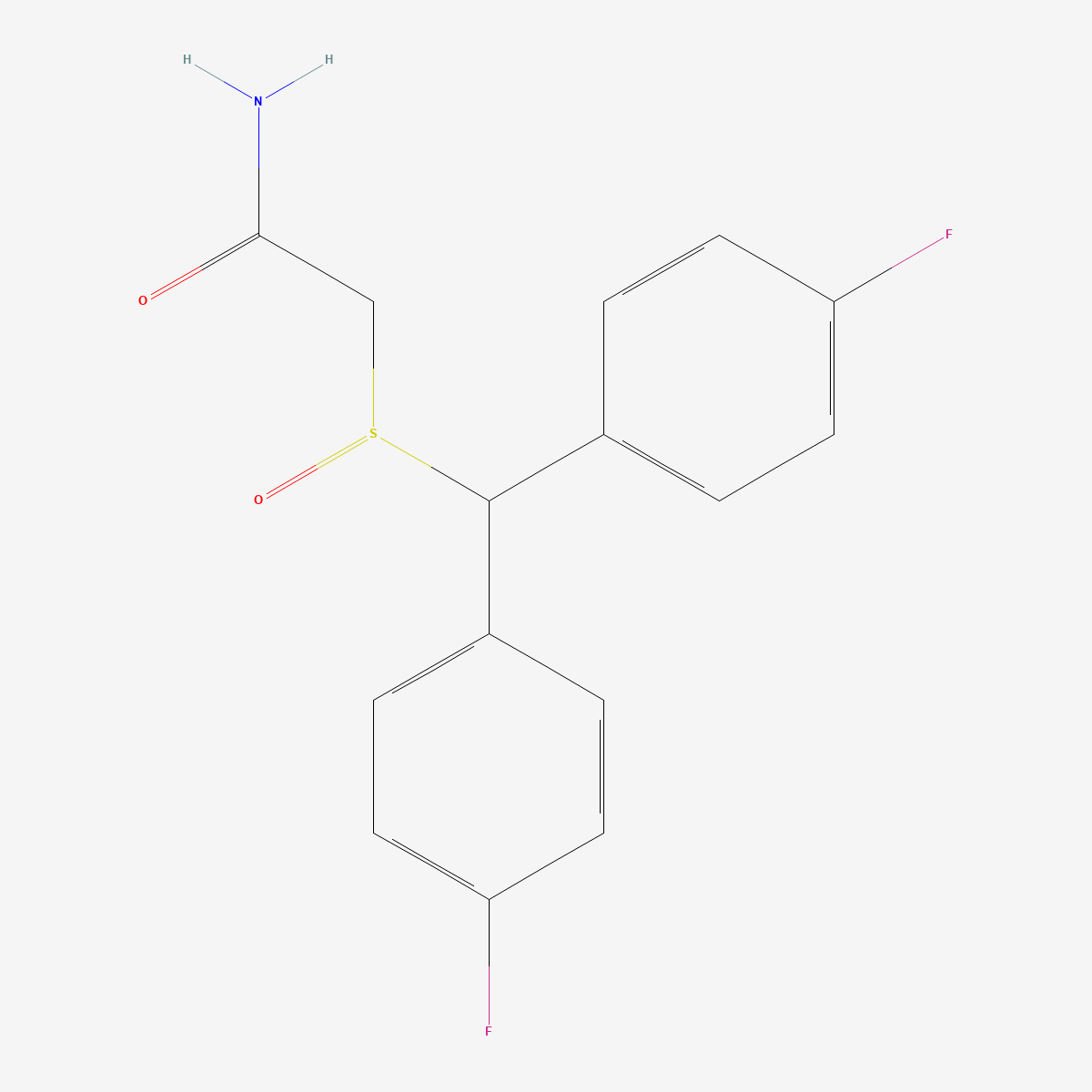
- Identity: 2-[bis(4-fluorophenyl)methylsulfinyl]acetamide (CAS 90280-13-0, C15H13F2NO2S, MW 309.3) — modafinil with a fluorine at the para position of each phenyl ring.
- Direct evidence base: five indexed papers. Only one, published in 2026, gave the compound to human volunteers.[1]
- Stereochemistry matters here: the sulfoxide sulfur is a stereocentre, and every in-vivo pharmacology study on this scaffold used a resolved single enantiomer,[2][3][4] whereas CAS 90280-13-0 denotes the compound with stereochemistry unspecified.
- Proposed mechanism: dopamine transporter inhibition with an “atypical” profile, demonstrated for the resolved enantiomers[3][4] and established in far more detail for the parent compound modafinil.[6]
- Analytical caution: the compound degrades in a hot gas chromatography injector, producing a fluorinated tetraphenylethane artefact rather than the expected parent signal.[5]
- Status: supplied as a reference standard for laboratory research. Not a medicine and not for human or animal consumption.
What the two fluorines change
Structurally the modification is minimal: modafinil’s benzhydryl group carries a fluorine at each para position and nothing else changes. The sulfinylacetamide head, the carbon skeleton and the stereocentre at sulfur are identical. The computed partition coefficient for the fluorinated compound is 1.9 against 1.7 for modafinil, so this is not a molecule transformed into something lipophilic; it remains in the same broad physicochemical class as its parent.
Para-fluorination is a standard medicinal-chemistry move whose usual purpose is to block aromatic hydroxylation at the most metabolically exposed position. Whether it achieves that here has not been tested by any comparative metabolism study of the two compounds side by side. The two human metabolites that have been identified — flmodafinil acid and flmodafinil sulfone[1] — both arise from transformations at the sulfinylacetamide end of the molecule rather than on the rings, which is consistent with the fluorinated positions being protected, but is not a controlled demonstration of it.
Counting the direct evidence, paper by paper
Because this is the crux of the article, the papers are set out explicitly rather than summarised. There are six — five below, plus one that most searches miss, described at the end of this section.
Krug and colleagues, 2026 — the only human administration study. Six volunteers ingested 20 mg of either flmodafinil or fladrafinil; urine and blood dried-blood-spot samples were analysed by LC-HRMS with limits of detection between 0.2 and 4 ng/mL. Two metabolites were detected after flmodafinil ingestion, flmodafinil acid and flmodafinil sulfone. Urinary maximum concentrations ranged from 191 to 891 ng/mL for flmodafinil and 52 to 111 ng/mL for fladrafinil; blood maxima were 45–98 and 11–35 ng/mL respectively. The authors report that fladrafinil acts as a prodrug for flmodafinil, with a measurable offset before flmodafinil reaches its maximum when the prodrug is given.[1]
Luca and colleagues, 2018 — the wake-promotion study. C57BL/6J mice received intraperitoneal vehicle, NLS-4 at 64 mg/kg, or modafinil at 150 mg/kg at light onset, with EEG and EMG recorded continuously for 24 hours. The 64 mg/kg dose was selected from a locomotor dose-response series of 32, 64, 128 and 256 mg/kg in eight animals. NLS-4 produced significantly longer wakefulness than modafinil at more than twice the dose. Neither compound produced significant sleep rebound, but modafinil-treated mice showed more NREM sleep than NLS-4-treated mice, and the increase in NREM delta power lasted only the first two time intervals after NLS-4 against nine after modafinil.[2]
Keighron and colleagues, 2019 — the dopamine transporter study. Fast-scan cyclic voltammetry and microdialysis in the nucleus accumbens shell of Sprague-Dawley rats compared (R)-modafinil with two enantiopure bis(fluoro) analogues, JBG1-048 and JBG1-049, given intravenously in cumulative doses. All three blocked the dopamine transporter, reduced the clearance rate of dopamine and raised extracellular dopamine, with differences between compounds in maximum stimulation and in time-course.[3]
Zanettini and colleagues, 2019 — the EEG classification study. In freely moving rats, cocaine and methylphenidate reduced power in the alpha, beta and gamma bands, whereas modafinil and its fluorinated analogue JBG1-049 reduced beta power only and left the other bands unchanged. The authors read this as an atypical dopamine-uptake-inhibitor profile for JBG1-049, with potency and effectiveness similar to modafinil.[4]
Dowling and colleagues, 2017 — the analytical study, discussed in its own section below.[5]
Bakota and Nandrea, 2025 — the sixth paper, and the one that ordinary searching does not return. Working at a US food-testing laboratory, the authors validated a liquid chromatography high-resolution mass spectrometry method quantifying modafinil alongside four unscheduled analogues, CRL-40,940 among them, and applied it to supplements bought on the open market.[8] It is worth knowing why it hides. Its abstract contains the string CRL-40,940 verbatim, yet a phrase query for that exact string does not retrieve it — the comma-containing token is parsed in a way that returns only the 2017 analytical paper. The record surfaces under difluoromodafinil instead. A compound whose literature is small enough to enumerate by hand is precisely the case where one missed record changes the count by twenty per cent, and where the failure is in the index rather than in the searcher.
The enantiomer problem
This deserves separating out, because it is the single most common source of over-reading in secondary descriptions of this compound.
Sulfoxides are chiral at sulfur. Luca and colleagues describe synthesising NLS-4 through asymmetric oxidation of the thioether precursor by the Kagan method, yielding the (R)-sulfoxide.[2] Keighron and colleagues describe JBG1-048 and JBG1-049 as enantiopure.[3] So all four in-vivo pharmacology results quoted above — wake promotion, dopamine transporter block, dopamine elevation, the atypical EEG signature — were obtained with single enantiomers.
Material identified by CAS 90280-13-0, and the corresponding PubChem record, carry no stereodescriptor. That the distinction is not academic is shown inside the Keighron study itself, which reports differences between the two resolved analogues in maximum stimulation of dopamine levels and in the time-course of their effects.[3] A result obtained on one enantiomer is therefore not automatically a result about the mixture. This is not a reason to discount the findings. It is a reason to record which chemical entity produced them, which is exactly what the primary papers do and what most downstream summaries omit.
One further precision: the 2018 paper’s introduction cites an unpublished contract-research screening result describing 83% dopamine transporter blockade, and a patent describing anti-aggressive effects in rats.[2] Neither is peer-reviewed data, and neither is treated as evidence in this article.
What is inherited from modafinil, and labelled as such
The following results concern modafinil, the parent compound, not the fluorinated analogue. They are included because the mechanistic frame applied to the analogue comes from them, and because using them without saying so is how inflated claims are produced.
Zolkowska and colleagues screened modafinil across a panel of receptors and transporters and found measurable potency at only one site, the dopamine transporter, with an IC50 of 4.0 µM for inhibition of [3H]dopamine uptake in rat brain synaptosomes. Intravenous modafinil at 20 and 60 mg/kg produced dose-dependent increases in motor activity and in extracellular dopamine in nucleus accumbens without affecting serotonin, and locomotor effects across the drugs tested correlated with dialysate dopamine.[6] The micromolar potency is worth noting: this is a weak transporter inhibitor compared with cocaine or methylphenidate.
Quisenberry and Baker trained rats to discriminate intragastric modafinil at 256 mg/kg from vehicle. The discrimination generalised completely to cocaine, methylphenidate and GBR 12909, and was blocked by both the D1 antagonist SCH 39166 and by haloperidol, with partial substitution by d-amphetamine, PNU-91356A and nicotine.[7] The dopaminergic dependence of the interoceptive effect is about as clearly demonstrated as a rodent design allows.
What does not transfer automatically is potency, selectivity or duration. No study has measured the fluorinated compound’s IC50 at the dopamine transporter alongside modafinil’s under identical conditions, so statements that it is “several times more potent” have no primary source behind them. The closest available comparison is behavioural: 64 mg/kg of the (R)-enantiomer produced longer wakefulness in mice than 150 mg/kg of modafinil,[2] which is a real difference in one assay, in one species, by one route, between two different chemical entities.
An analytical trap worth knowing about
Dowling and colleagues examined what happens to modafinil, modafinic acid, adrafinil, CRL-40,940 and CRL-40,941 when they pass through a heated gas chromatography injection port. Modafinil and its non-fluorinated relatives degrade to diphenylmethanol and 1,1,2,2-tetraphenylethane, the latter confirmed by independent synthesis and X-ray crystallography. The fluorinated compounds, CRL-40,940 among them, generate the corresponding tetrafluoro analogue of tetraphenylethane. When a fluorinated and a non-fluorinated compound were injected together, a third cross-reaction product appeared.[5]
The practical consequence for anyone verifying identity is direct: a GC-MS run on this compound can return a chromatogram dominated by a thermal artefact rather than by the analyte, and mixed samples can generate peaks that correspond to no substance actually present. The same paper reports 1H and 13C NMR characterisation, which is the more reliable route. LC-based methods, as used in the 2026 human study,[1] avoid the problem entirely.
Where this leaves the mechanism question
The honest summary is narrow. The compound is a bis(para-fluoro) analogue of a drug whose principal measured molecular action is weak dopamine transporter inhibition. Its resolved enantiomers block the dopamine transporter in rats and raise extracellular dopamine, and one of them shows an EEG signature that separates it from cocaine-like uptake inhibitors. One enantiomer promotes wakefulness in mice more durably than a larger dose of modafinil. In humans, a 20 mg dose yields measurable parent compound and two identified metabolites in urine and blood.
Nothing in that set establishes a mechanism distinct from modafinil’s, and nothing in it excludes one. There is no receptor-panel screen of the fluorinated compound, no comparative binding affinity, no human pharmacodynamic study, and no published work on the racemic material at all.
Frequently asked questions
Is FLModafinil the same thing as modafinil?
No. It is a distinct chemical entity, CAS 90280-13-0, differing by a fluorine atom at the para position of each phenyl ring. It also differs from fladrafinil (CRL-40,941), the N-hydroxy compound, which the 2026 human study reports acts as a prodrug converting to flmodafinil.[1]
How many studies have actually been done on FLModafinil?
Five indexed papers address this chemical entity or its resolved enantiomers directly: one human elimination study,[1] one mouse sleep-EEG study using the (R)-enantiomer,[2] two rat studies using enantiopure analogues,[3][4] and one analytical chemistry paper.[5] Anything beyond that in circulation is either modafinil literature applied by analogy or unsourced.
Is FLModafinil detectable in anti-doping testing?
Yes. Flmodafinil and fladrafinil fall under class S6 stimulants of the World Anti-Doping Agency Prohibited List and are prohibited in competition. The 2026 study established detection methods with limits between 0.2 and 4 ng/mL and reported relatively long detection windows for both the intact compounds and their metabolites, leading the authors to advise careful interpretation of adverse analytical findings.[1]
What purity and characterisation are appropriate for a reference standard here?
Material characterised at ≥99% by a stated assay method is the practical minimum, and given the gas-chromatography artefact described above, identity should be confirmed by NMR or by an LC-based method rather than by GC-MS alone. Our FLModafinil reference standard (CAS 90280-13-0) ships with identity documentation available on request.
Related compounds in our catalogue
Researchers working on this scaffold ordinarily run the parent compound alongside the analogue, and our modafinil reference material (CAS 68693-11-8) is the direct structural comparator for the studies described above. For a wakefulness-associated compound with an unrelated proposed mechanism, bromantane (CAS 87913-26-6) acts through changes in enzyme expression rather than transporter binding.
References
- Krug O, Guddat S, Görgens C, Walpurgis K, Toma F, Thomas A, Thevis M. Investigations Into the Metabolism and Elimination of Flmodafinil and Fladrafinil for Sports Drug Testing Purposes. Drug Testing and Analysis. 2026;18(8):1076–1087. doi:10.1002/dta.70100
- Luca G, Bandarabadi M, Konofal E, Lecendreux M, Ferrié L, Figadère B, Tafti M. Lauflumide (NLS-4) Is a New Potent Wake-Promoting Compound. Frontiers in Neuroscience. 2018;12:519. doi:10.3389/fnins.2018.00519
- Keighron JD, Giancola JB, Shaffer RJ, DeMarco EM, Coggiano MA, Slack RD, Newman AH, Tanda G. Distinct effects of (R)-modafinil and its (R)- and (S)-fluoro-analogs on mesolimbic extracellular dopamine assessed by voltammetry and microdialysis in rats. European Journal of Neuroscience. 2019;50(3):2045–2053. doi:10.1111/ejn.14256
- Zanettini C, Scaglione A, Keighron JD, Giancola JB, Lin SC, Newman AH, Tanda G. Pharmacological classification of centrally acting drugs using EEG in freely moving rats: an old tool to identify new atypical dopamine uptake inhibitors. Neuropharmacology. 2019;161:107446. doi:10.1016/j.neuropharm.2018.11.034
- Dowling G, Kavanagh PV, Talbot B, O’Brien J, Hessman G, McLaughlin G, Twamley B, Brandt SD. Outsmarted by nootropics? An investigation into the thermal degradation of modafinil, modafinic acid, adrafinil, CRL-40,940 and CRL-40,941 in the GC injector: formation of 1,1,2,2-tetraphenylethane and its tetra fluoro analog. Drug Testing and Analysis. 2017;9(3):518–528. doi:10.1002/dta.2142
- Zolkowska D, Jain R, Rothman RB, Partilla JS, Roth BL, Setola V, Prisinzano TE, Baumann MH. Evidence for the involvement of dopamine transporters in behavioral stimulant effects of modafinil. Journal of Pharmacology and Experimental Therapeutics. 2009;329(2):738–746. doi:10.1124/jpet.108.146142
- Quisenberry AJ, Baker LE. Dopaminergic mediation of the discriminative stimulus functions of modafinil in rats. Psychopharmacology (Berlin). 2015;232(24):4411–4419. doi:10.1007/s00213-015-4065-0
- Bakota EL, Nandrea JM. Development and Validation of an Analytical Method to Identify and Quantitate Novel Modafinil Analogs in Products Marketed as Dietary Supplements. Journal of Dietary Supplements. 2025;22(2):329–344. doi:10.1080/19390211.2024.2417673
Research use only. The compounds discussed are supplied as reference standards for laboratory research. They are not medicines, not dietary supplements, and are not for human or animal consumption. Nothing in this article is medical advice or a recommendation for use in humans. Any quantities mentioned are those reported in the published studies cited above and appear solely to describe that research accurately.