Mebicar looks like an easy analyte. It is small, neutral, achiral, 198 g/mol, and its structure fits on one line. In practice it resists almost every default method an analytical laboratory would reach for: it has no useful UV chromophore, it is polar enough to elute near the void volume on C18, and its molecular symmetry collapses the proton NMR spectrum to two singlets. Compounding this, a PubMed query for mebicar combined with chromatography, HPLC or liquid chromatography returns nothing. Forty-five years of pharmacological literature exist for this compound and essentially no analytical literature does.
Key points
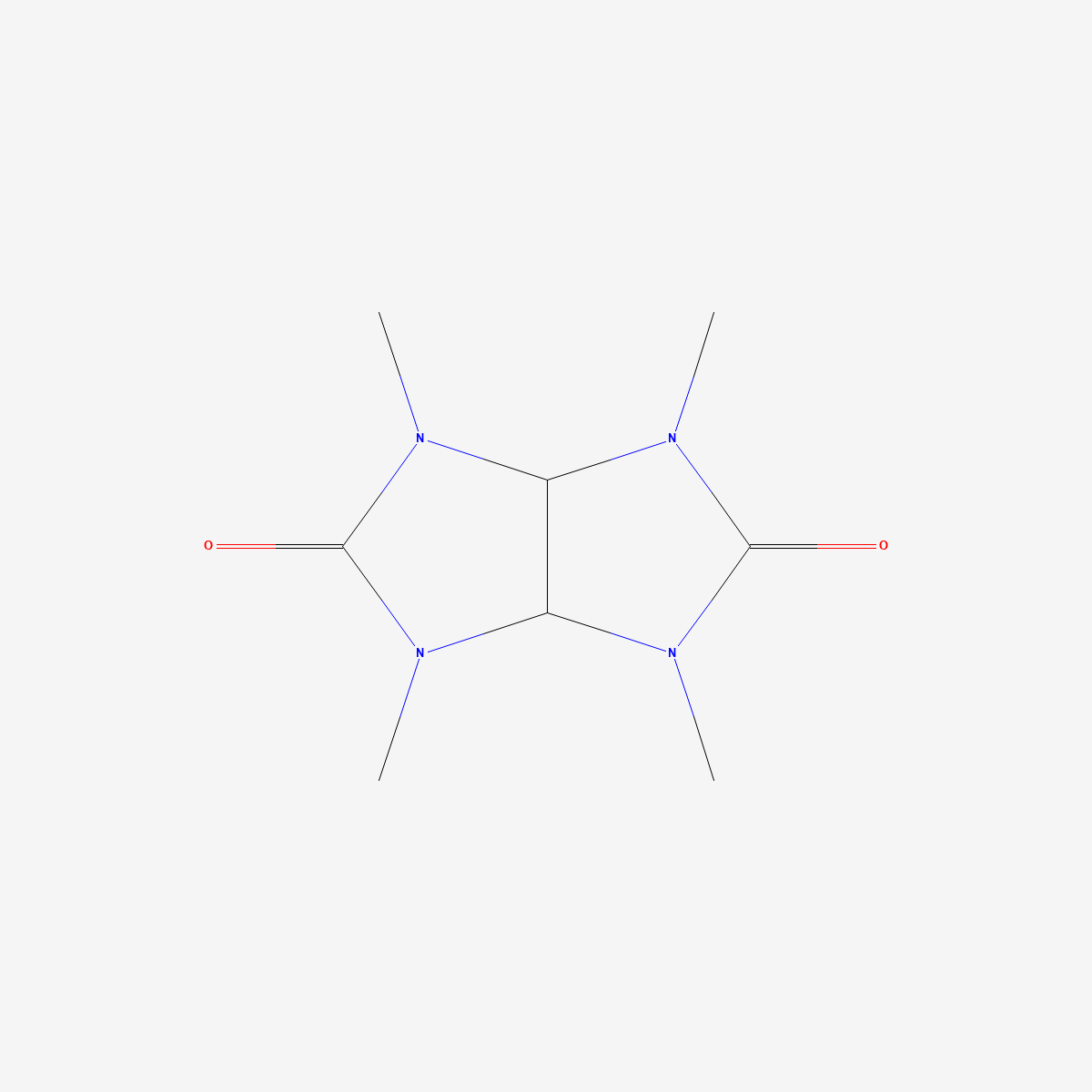
- Compound: mebicar (mebikar, adaptol), CAS 10095-06-4, C8H14N4O2, MW 198.22 — 2,4,6,8-tetramethyl-2,4,6,8-tetraazabicyclo[3.3.0]octane-3,7-dione, i.e. tetramethylglycoluril. The primary pharmacology literature classifies it as a derivative of the bicyclic bis-ureas.[3]
- Exact mass: monoisotopic 198.1117; [M+H]+ at m/z 199.1190 for C8H15N4O2+. Useful, because mass spectrometry is one of the few detection modes that works well here.
- No chromophore: two isolated urea carbonyls and no extended conjugation. Detection defaults to low-UV end-absorption with poor selectivity, or to detection modes that do not require a chromophore at all — evaporative light scattering, charged aerosol or MS.
- High polarity: a neutral, hydrogen-bonding solute that reversed-phase columns retain weakly. Hydrophilic interaction chromatography is the mode designed for exactly this class.[6]
- Analytical literature: one indexed method paper, a ceriometric titration published in Farmatsiia in 1979.[1] Zero indexed chromatographic methods.
- Status: supplied as a reference standard for laboratory research. Not a medicine and not for human or animal consumption.
The structure decides the method
Glycoluril is two five-membered cyclic ureas fused across a shared carbon–carbon bond. In mebicar all four ring nitrogens carry methyl groups, which removes every N–H from the molecule. What remains is a compact, rigid, neutral bicycle with two carbonyls and eight methyl and methine hydrogens.
Three consequences follow directly, and each one eliminates a standard technique.
First, there is no ionisable group. Ureas are extremely weak bases, and N-tetramethylation removes the acidic protons. Across the entire working pH range of a silica-based column, mebicar is neutral. Ion-pairing has nothing to pair with, and ion-exchange has nothing to exchange. Methods that depend on manipulating charge to gain retention or selectivity simply do not apply.
Second, there is no chromophore worth the name. The carbonyls are isolated amide-type groups with no conjugation to anything, so absorbance is confined to the far-UV region where mobile-phase components, dissolved oxygen and trace impurities all absorb as well. A 210 nm trace for a compound like this is not a selective measurement; it is a record of everything in the injection that also absorbs at 210 nm. This is why detection that responds to mass rather than to electronic transitions is the sensible default, and why the combination of hydrophilic interaction chromatography with evaporative light scattering has a track record specifically for polar compounds lacking chromophores.[8]
Third, the molecule is symmetrical. The two fused rings are equivalent, and within them the methyl-bearing nitrogens are related by symmetry. The expected proton spectrum is therefore about as sparse as an organic spectrum can be: one signal for twelve equivalent N-methyl protons and one for the two bridgehead methines. That is trivially easy to acquire and correspondingly weak as a discriminator. A clean two-singlet spectrum is consistent with mebicar — and also with rather little else being ruled out, since it carries almost no structural information beyond the methyl-to-methine ratio.
The symmetry does buy one genuinely useful thing. Incompletely methylated glycolurils — mono-, di- and trimethyl species — break that symmetry and produce additional methyl environments. They are therefore visible in the proton spectrum as extra singlets, even when they are invisible by low-UV chromatography. For a compound made by exhaustive methylation of a glycoluril core, those partially methylated congeners are the most plausible process-related impurities, and NMR sees them better than the chromatography does.
Retention: why C18 is the wrong first choice
A small, neutral, heavily hydrogen-bonding solute with four nitrogens and two oxygens over eight carbons has very little hydrophobic surface to offer a C18 phase. Under the aqueous conditions such a solute needs in order to dissolve, retention on a conventional reversed-phase column is minimal, and a peak eluting at or near the void volume cannot be separated from anything else that also fails to retain — which, in a real sample, includes salts, polar degradants and matrix.
Hydrophilic interaction liquid chromatography inverts the problem. It uses a polar stationary phase with a high-organic mobile phase, so polar solutes are the ones that retain. Reviews of its pharmaceutical applications list three advantages that map onto mebicar’s specific difficulties: mobile phases with high water solubility that improve dissolution of hydrophilic and polar ionic compounds; no requirement for ion-pairing reagents, combined with high organic content that benefits mass spectrometric detection; and high orthogonality to reversed-phase separation, which makes the two modes complementary rather than redundant.[6] The same mode is long established in bioanalysis for exactly this reason.[7]
Where a method has to resolve the compound, its counterions or salts, and polar excipients in one run, mixed-mode approaches that couple ion-exchange/reversed-phase columns with a hydrophilic interaction column can handle chemically diverse analytes in a single analysis.[9] For a compound with no monograph and no published method, that flexibility matters more than it would for a well-characterised substance.
What the literature actually contains — and does not
An honest account of mebicar’s evidence base has to separate volume from relevance. PubMed indexes roughly seventy records under mebicar and its transliteration mebikar. The great majority are Russian- and Ukrainian-language clinical reports from the 2010s on anxiety, autonomic dysfunction, asthenic syndromes and cardiology. They are clinical observations, not chemistry.
The foundational pharmacology is from the late 1970s and early 1980s. Zimakova’s 1977 report characterised the compound as occupying a position between tranquillisers and neuroleptics: inhibiting the orientation reaction in albino mice, potentiating narcotic hypnotics, abolishing conditioned avoidance, displaying central adrenolytic activity, and showing low toxicity with no direct spasmolytic action on isolated organs.[3] Val’dman and colleagues reported in 1980 that in cats under group interaction the compound eliminated fear-alarm induced by stimulation of the emotiogenic zone of the hypothalamus without accompanying myorelaxant or hypnotic effects, decreased brain noradrenaline, increased brain serotonin, had no effect on dopaminergic systems and showed no cholinolytic action.[4]
The analytical record is a single paper: a quantitative ceriometric determination published in Farmatsiia in 1979.[1] A cerium(IV) redox titration is a reasonable bulk assay for a pure substance with 1979 equipment, but it is worth being clear about what it is not. It is not an identity test, it is not stability-indicating, and it responds to any oxidisable species in the sample rather than to mebicar specifically. Two clinical pharmacokinetic papers from the mid-1980s imply that a bioanalytical assay existed — one reporting pharmacokinetic parameters alongside psychometric mapping and concurrent EEG in twenty-two patients after a single dose,[2] the other setting out principles for calculating individual dosage regimens[5] — but the indexed records do not describe the method.
A query for mebicar together with HPLC returns exactly one record, and it is not a method for mebicar: a 2023 study of Patrinia scabiosifolia extract in which HPLC-MS was used to confirm active components in the plant material, with mebicar serving as the reference comparator in the behavioural work.[10] Queries pairing mebicar or adaptol with chromatography or liquid chromatography return nothing at all.
Recent non-Russian work is scarce but does exist. Kim and colleagues gave Balb/cByJ mice mebicar at 10 mg/kg orally from one week before exposure to intermittent unpredictable stress. The treatment did not inhibit stress-induced hyperactivity or anxiety-like behaviour and did not prevent the fall in brain-derived neurotrophic factor, but it did prevent elevation of serum corticosterone and secretion of proinflammatory cytokines from splenocytes, leading the authors to conclude that the anti-stress effect may be restricted to peripheral stress responses.[11] That is a narrower and more sceptical result than the older literature, and it comes from an independent group — which, for a compound with this publication history, is the more informative fact about it.
A practical characterisation package
Because there is no monograph to follow, identity and purity for mebicar have to be assembled from orthogonal measurements rather than taken from a compendium:
- Accurate mass confirming C8H14N4O2 via [M+H]+ at m/z 199.1190, with the measured error stated. The nitrogen-rich composition helps here: four nitrogens constrain the plausible formula space considerably at a given accurate mass.
- Proton and carbon NMR read specifically as a test for asymmetry. The value is in what should not be there — additional methyl singlets indicating partially methylated glycolurils.
- Chromatographic purity by HILIC with aerosol-based or mass-spectrometric detection rather than low-UV absorbance,[6][8] and ideally a second, orthogonal separation, since a single method on an unstudied compound establishes very little about what it fails to resolve.
- Absolute content by quantitative NMR against an internal standard, which avoids the circularity of calibrating a compound against itself when no certified reference material exists.
- Water content by Karl Fischer titration. A small, polar, hydrogen-bond-accepting solid of this type is a plausible candidate for hygroscopicity, and undeclared water is a systematic error in every gravimetric preparation made from the batch.
Frequently asked questions
Why does mebicar give such a weak UV signal?
Because it has no conjugated system. The only chromophores are two isolated urea carbonyls, which absorb in the far-UV region where mobile-phase components absorb too. Detection at 210 nm is possible but unselective. Evaporative light scattering, charged aerosol detection and mass spectrometry all respond to the analyte without needing electronic absorbance, and are the more appropriate choices.[8]
Why does mebicar elute near the void volume on a C18 column?
Four nitrogens and two oxygens across an eight-carbon skeleton leave very little hydrophobic surface for a C18 phase to interact with, so retention under the aqueous conditions the compound requires is minimal. Hydrophilic interaction chromatography retains polar solutes by the opposite mechanism and is the standard answer for this class of analyte.[6][7]
How much research exists on mebicar?
Around seventy indexed records, overwhelmingly Russian- and Ukrainian-language clinical reports, with the foundational pharmacology dating from 1977–1980.[3][4] Independent replication outside that literature is rare; one recent example is a 2018 mouse study from a Korean group.[11] Analytically the record is thinner still — a single 1979 titrimetric method[1] and no indexed chromatographic assay.
What should a mebicar reference standard come with?
An assay value with the method that produced it, identity data by at least two orthogonal techniques, and a water content figure. Our mebicar reference material (CAS 10095-06-4) is supplied with identity and purity documentation available on request; given the absence of a pharmacopoeial monograph, laboratories should expect to confirm suitability against their own method rather than against a compendial specification.
Related compounds in our catalogue
The same characterisation problems recur across this part of the catalogue: PRL-8-53 reference standard (CAS 51352-87-5) has a single primary publication and two molar masses in common circulation depending on salt form, while bromantane (CAS 87913-26-6) presents the opposite chromatographic difficulty — a lipophilic adamantane cage with poor aqueous solubility.
References
- Pavlova VM, Berliand AS, Knizhnik AZ. Quantitative ceriometric determination of mebicar. Farmatsiia. 1979;28(2):31–34. PMID: 35380
- Serov NV, Treskov VG, Berliand AS, Knizhnik AZ, Lapin KV. Clinical pharmacokinetics of mebikar. Farmakologiia i Toksikologiia. 1984;47(3):94–97. PMID: 6734814
- Zimakova IE. Pharmacological effects of the new psychotropic preparation, mebikar. Farmakologiia i Toksikologiia. 1977;40(6):684–687. PMID: 598490
- Val’dman AV, Zaikonnikova IV, Kozlovskaia MM, Zimakova IE. Characteristics of the psychotropic spectrum of action of mebicar. Biulleten’ Eksperimental’noi Biologii i Meditsiny. 1980;89(5):568–570. PMID: 6104993
- Treskov VG, Berliand AS, Serov NV, Sidorov AA, Knizhnik AZ. Clinical pharmacokinetics of mebikar. Computation of individual dosage regimens. Farmakologiia i Toksikologiia. 1985;48(1):46–48. PMID: 3979535
- Zhang Q, Yang FQ, Ge L, Hu YJ, Xia ZN. Recent applications of hydrophilic interaction liquid chromatography in pharmaceutical analysis. Journal of Separation Science. 2017;40(1):49–80. doi:10.1002/jssc.201600843 · PMID: 27717145
- Xu RN, Rieser MJ, El-Shourbagy TA. Bioanalytical hydrophilic interaction chromatography: recent challenges, solutions and applications. Bioanalysis. 2009;1(1):239–253. doi:10.4155/bio.09.12 · PMID: 21083199
- Risley DS, Strege MA. Chiral separations of polar compounds by hydrophilic interaction chromatography with evaporative light scattering detection. Analytical Chemistry. 2000;72(8):1736–1739. doi:10.1021/ac9911490 · PMID: 10784135
- Kazarian AA, Nesterenko PN, Soisungnoen P, Burakham R, Srijaranai S, Paull B. Comprehensive analysis of pharmaceutical products using simultaneous mixed-mode (ion-exchange/reversed-phase) and hydrophilic interaction liquid chromatography. Journal of Separation Science. 2014;37(16):2138–2144. doi:10.1002/jssc.201400411 · PMID: 24890905
- Zorikova O, Manyakhin A, Kolyada N, Malysheva S, Loboda A. Evaluation of the anxiolytic activity of dry extract of Patrinia scabiosifolia under acoustic stress. European Review for Medical and Pharmacological Sciences. 2023;27(24):11701–11712. doi:10.26355/eurrev_202312_34767 · PMID: 38164833
- Kim CY, Kim YG, Sin SJ, Koo H, Cheon K, Kim D. Preventive effect of mebicar and ginsenoside Rg1 on neurobehavioral and immunological disruptions caused by intermittent unpredictable stress in mice. Neuroimmunomodulation. 2018;25(1):49–58. doi:10.1159/000489634 · PMID: 29920498
Research use only. The compounds discussed are supplied as reference standards for laboratory research. They are not medicines, not dietary supplements, and are not for human or animal consumption. Nothing in this article is medical advice or a recommendation for use in humans. Any quantities mentioned are those reported in the published studies cited above and appear solely to describe that research accurately.