A PubMed search for PRL-8-53 returns exactly one record. Searching instead by author turns up a second, published four years earlier under a chemical name that differs by a single space — and describing the compound as a spasmolytic, not a memory agent. Two papers, then, both by the same chemist, the later one from 1978. Nearly half a century on there is still no replication by anyone else, no independent pharmacokinetic study and no published analytical method for the compound. When a molecule’s literature is one paper deep, the analytical data travelling with the material stop being paperwork and become the only evidence you have about what is in the vial. The first thing those data have to settle is which of two molecular formulae applies, because PRL-8-53 is routinely written both ways and the two differ by 12.9% in molar mass.
Key points
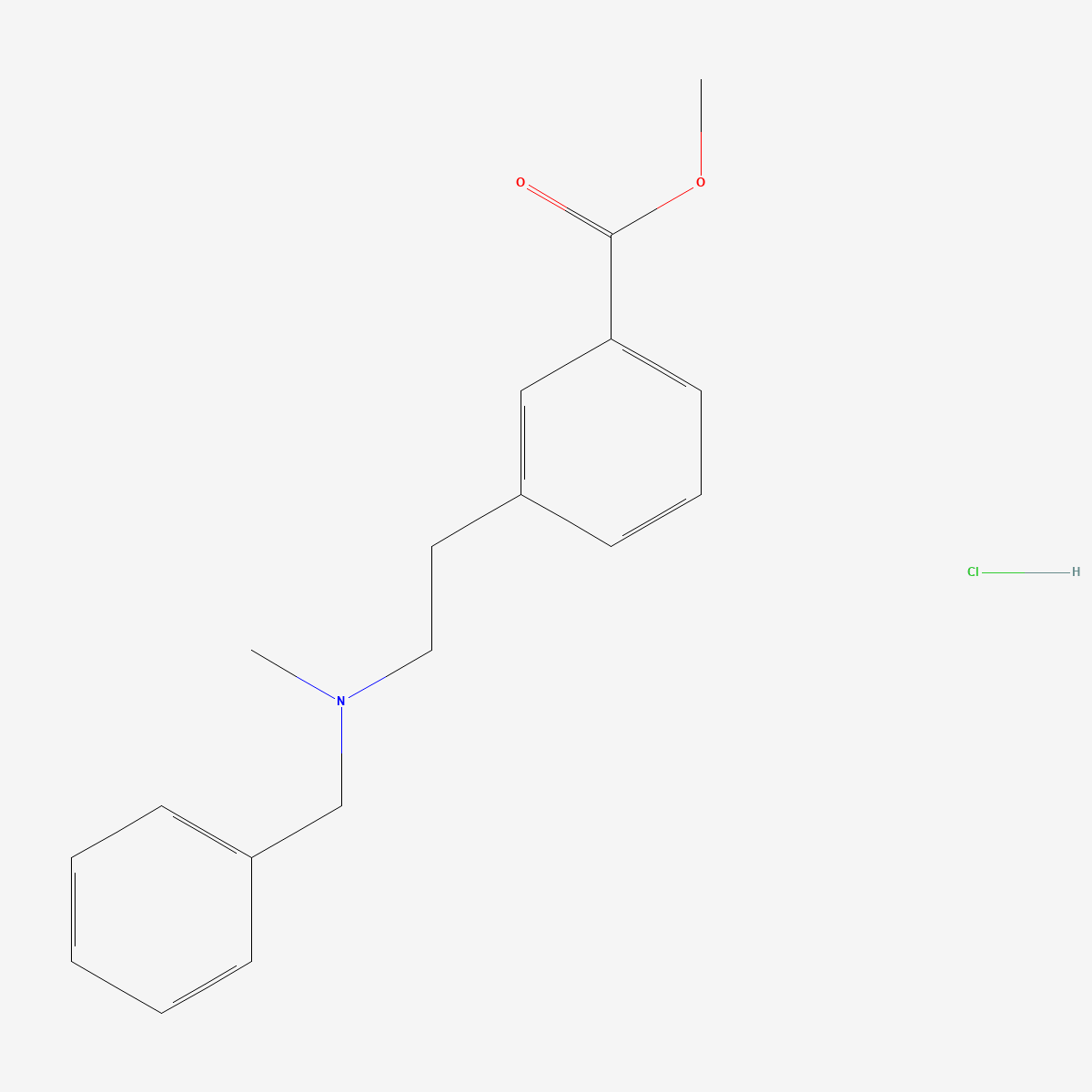
- Compound: PRL-8-53, CAS 51352-87-5, described in the primary literature as 3-(2-benzylmethylaminoethyl)benzoic acid methyl ester hydrochloride — in modern nomenclature, methyl 3-{2-[benzyl(methyl)amino]ethyl}benzoate hydrochloride.[1]
- Two formulae, one HCl apart: the free base is C18H21NO2, MW 283.37; the hydrochloride is C18H22ClNO2, MW 319.83. Both are correct descriptions of PRL-8-53 — of different forms of it.
- Why it matters: 319.83/283.37 = 1.1287. Weighing the hydrochloride and calculating with the free-base mass overstates molarity by 12.9%; the salt is only 88.6% free base by mass.
- Evidence base: one indexed primary study, a 1978 double-blind verbal-learning experiment. No chromatographic method, no impurity profile and no spectroscopic characterisation for this compound appear in the indexed literature.
- Analytical handles: a tertiary benzylamine, basic and readily protonated in positive electrospray, and a meta-substituted aryl methyl ester that supplies both a UV chromophore and a hydrolysis-prone bond. No stereocentre, so no chiral method is required.
- Status: supplied as a reference standard for laboratory research. Not a medicine and not for human or animal consumption.
A literature of two, and why it looks like one
The search is worth running yourself, because the result is unusual enough to be worth seeing directly — and because it understates the case. Querying PubMed for PRL-8-53, for the CAS number 51352-87-5, and for the structural fragment benzylmethylaminoethyl all converge on the same single record: Hansl NR, Mead BT, Psychopharmacology (Berl) 1978;56(3):249–53.[1]
Three independent-looking queries agreeing is normally reassuring. Here it is an artefact. Searching by author instead of by compound returns a second paper on the same molecule, four years earlier: Hansl NR, Experientia 1974;30(3):271–2, titled A novel spasmolytic and CNS active agent: 3-(2-benzylmethylamino ethyl) benzoic acid methyl ester hydrochloride. That chemical name is the 1978 compound’s name with one space inserted — benzylmethylamino ethyl rather than benzylmethylaminoethyl — and a single space is enough to make a string query miss it. The 1974 record carries no indexed abstract, so nothing is claimed here about what it found; the indexing terms describe work on smooth muscle and cardiovascular parameters, which places the compound’s origin in antispasmodic chemistry rather than in memory research. The practical lesson generalises beyond this molecule: agreement between queries that share a spelling is not independent confirmation.
What that paper reports is narrow and stated plainly. Using the serial anticipation method under double-blind conditions, the authors found slight improvement of acquisition and improvement of verbal retention that reached statistical significance — most P values better than 0.01, some better than 0.001 — with no significant change in visual reaction time or motor control relative to placebo.[1] That is the entire primary evidence base. Anything written about this compound that goes beyond it is extrapolation, and anything that appears to cite additional studies is worth checking against the index before it is repeated.
For an analyst this is not merely a historical curiosity. It means there is no published retention behaviour to compare against, no reported impurity profile, no interlaboratory purity data and no authoritative melting point to check a sample against. Every one of those has to be generated locally or supplied with the material.
Two formulae, one compound: where the 36.46 goes
PRL-8-53 carries one basic nitrogen — the tertiary amine bearing a benzyl group and a methyl group. Treating the free base with hydrogen chloride protonates that nitrogen and gives a crystalline ammonium chloride salt. Nothing in the carbon skeleton changes. The formula gains one H and one Cl, and the molar mass gains 36.46 g/mol:
- Free base: C18H21NO2, MW 283.37 g/mol
- Hydrochloride: C18H22ClNO2, MW 319.83 g/mol
Both descriptions appear in circulation, and neither is wrong in itself. What is wrong is mixing them. The 1978 paper names the hydrochloride explicitly, which is the usual situation for an amine of this type: the salt is the isolable, weighable, storable form, while the free base is the more awkward one to handle and the easier one to oxidise.
The arithmetic of the mismatch is worth writing out, because it is easy to underestimate. Suppose 10.0 mg of hydrochloride is weighed into 1.00 mL of solvent. Using 319.83 g/mol gives 31.3 mmol/L. Using 283.37 g/mol gives 35.3 mmol/L. The true free-base content of that solution is 8.86 mg, because the salt is 88.6% base by mass. A 12.9% systematic error is larger than the acceptance window of most assays and larger than the spacing of many dose–response series, and unlike random error it does not average out across replicates — it displaces every point in the same direction.
The practical rule is a documentation rule rather than a chemistry one: record which form the analytical data describe, state that form in the methods section alongside the CAS number, and apply the conversion factor explicitly rather than assuming that a molar mass quoted in a catalogue, a database entry or a specification sheet refers to the material actually in hand.
Why mass spectrometry cannot answer the salt question
The instinctive response to a salt-form question is to run the sample by LC-MS. It will not help, and understanding why is useful more generally.
In electrospray ionisation the counterion is lost in the source. The free base and the hydrochloride of PRL-8-53 give the same protonated species, [M+H]+ at m/z 284.1645 for C18H22NO2+, and the same fragmentation. A high-resolution measurement confirms the elemental composition of the cation to a few parts per million and says nothing whatsoever about whether a chloride was sitting beside it in the solid. The same applies to ordinary reversed-phase chromatography: the salt dissociates in the mobile phase, so both forms co-elute.
Settling the salt form requires a method that looks at the counterion rather than at the cation. Ion chromatography and mixed-mode ion-exchange/reversed-phase separations are the standard approach, and methods exist that resolve inorganic anions, active ingredients and organic counterions within a single run.[8] Classical argentometric chloride titration answers the same question with cheaper equipment. Elemental analysis reaches it by a third route, since the two forms differ substantially in their carbon and hydrogen percentages.
The distinction between what an instrument confirms and what it merely fails to contradict is the same one that underlies the widely used framework for communicating identification confidence in high-resolution mass spectrometry, which separates a confirmed structure from a probable one and from a bare molecular formula.[2] A correct accurate mass sits at a lower confidence level than it appears to.
Structural handles: what the molecule offers an analyst
Three features of the structure determine what methods will work.
The tertiary benzylamine. It is basic, so the compound is cationic at low and neutral pH and neutral at high pH. That governs reversed-phase retention, which will be strongly pH-dependent and prone to peak tailing on silica with accessible residual silanols. It also makes positive-mode electrospray efficient, which is convenient for trace work but, as above, uninformative about the solid form.
The aryl methyl ester. The benzoate ring supplies the principal UV chromophore, so the compound is detectable by conventional HPLC with ultraviolet absorbance in the mid-200 nm region. The ester bond is also the obvious degradation route: hydrolysis, base-catalysed in particular, converts it to the corresponding free benzoic acid. A purity method that is not stability-indicating — one that does not resolve that acid from the parent — reads partial hydrolysis as intact compound. Since no forced-degradation study for this molecule exists in the literature, demonstrating that resolution is a local obligation rather than something to be taken from a monograph.
No stereocentre. Neither the amine nitrogen nor any carbon in the chain is stereogenic, so there is no enantiomeric purity question and no need for a chiral column. That removes an entire class of specification, which is worth confirming explicitly rather than assuming.
A defensible identity and purity package
For a compound with no reference method in the literature, a minimum useful data set is neither exotic nor especially expensive:
- Accurate mass by high-resolution MS establishing the elemental composition of the cation, with the mass error stated rather than implied.
- NMR consistent with the structure. The expected proton spectrum is diagnostic without being complicated: a methyl ester singlet, a benzylic methylene, an N-methyl singlet, and an aromatic region combining a monosubstituted phenyl with the four-proton pattern characteristic of a 1,3-disubstituted ring, including the narrow signal for the proton between the two substituents. Absence of that meta pattern would indicate the wrong substitution isomer — a failure mode no mass measurement can detect, because positional isomers are isobaric.
- Absolute purity by quantitative NMR. qNMR determines content against an internal standard of a different substance, which is exactly the situation here, since no certified standard of PRL-8-53 exists to calibrate against. Precision and accuracy of around 1% are achievable with routine instrumentation, and qNMR can replace combustion analysis or multi-determination mass-balance approaches when no substance-specific standard is available.[3] The approach has been applied to calibrate reference standards for which no prior certified material existed, with results showing no significant difference from mass-balance determination.[4]
- Chromatographic purity using a method demonstrated to resolve the hydrolysis product.
- Counterion determination fixing the salt form and therefore the molar mass used in every downstream calculation.[8]
Why label claims on sparsely documented compounds need checking
Scepticism about supplied material is not a theoretical posture. The most systematic data come from surveys of over-the-counter products marketed for cognitive enhancement, a market that overlaps heavily with the research-chemical supply chain.
Cohen and colleagues analysed ten products labelled as containing omberacetam, aniracetam, phenylpiracetam or oxiracetam using non-targeted liquid chromatography–quadrupole time-of-flight mass spectrometry. Several detected drugs were not declared on the label, several declared drugs were not detected at all, and among the products that stated a quantity, 75% (9 of 12) of the declared quantities were inaccurate.[5] A later study of seven products declaring centrophenoxine found the compound present in all of them, but only one of the seven (14%) listed a quantity within ±10% of the measured amount.[6] A separate analysis identified piracetam in products sold as dietary supplements.[7]
Those figures describe consumer products rather than laboratory reagents, and the distinction matters. What they establish is a base rate: for compounds outside pharmacopoeial oversight, a printed number is not a measurement. For a compound with a single primary publication and two molar masses in common circulation, the receiving laboratory carries more of the analytical burden than usual and should budget for it.
Frequently asked questions
How many studies have been published on PRL-8-53?
One indexed primary study: Hansl and Mead, 1978.[1] Searches by compound name, by CAS number and by structural fragment all converge on that single record. There is no replication, no independent pharmacokinetic work and no published analytical method. Any account of this compound implying a broader literature is not describing what the index actually holds.
What is the molecular weight of PRL-8-53 — 283 or 320?
Both, depending on the form. The free base C18H21NO2 has MW 283.37; the hydrochloride C18H22ClNO2 has MW 319.83. The primary literature describes the hydrochloride. The two differ by one HCl, and using the wrong one shifts every calculated concentration by 12.9%, so the form belongs in the record explicitly rather than being inferred.
Can mass spectrometry tell me whether I have the hydrochloride or the free base?
No. Electrospray strips the counterion, so both forms give [M+H]+ at m/z 284.1645 with identical fragmentation. The question is answered by counterion methods — ion chromatography, mixed-mode separation[8] or argentometric chloride titration — or indirectly by elemental analysis, since carbon and hydrogen percentages differ measurably between the two forms.
What documentation should accompany a PRL-8-53 reference standard?
At minimum: the salt form stated unambiguously with the corresponding molar mass, an assay value together with the method that produced it, and identity data consistent with the structure. Our PRL-8-53 reference standard (CAS 51352-87-5) is supplied as the hydrochloride, with identity and purity documentation available on request.
Related compounds in our catalogue
Laboratories building methods for sparsely documented compounds run into closely related problems with mebicar reference material (CAS 10095-06-4), a highly polar glycoluril with almost no useful chromophore, and with noopept (CAS 157115-85-0), whose hydrolysable ester makes a stability-indicating method mandatory rather than optional.
References
- Hansl NR, Mead BT. PRL-8-53: enhanced learning and subsequent retention in humans as a result of low oral doses of new psychotropic agent. Psychopharmacology (Berl). 1978;56(3):249–253. doi:10.1007/BF00432846 · PMID: 418433
- Schymanski EL, Jeon J, Gulde R, Fenner K, Ruff M, Singer HP, Hollender J. Identifying small molecules via high resolution mass spectrometry: communicating confidence. Environmental Science & Technology. 2014;48(4):2097–2098. doi:10.1021/es5002105 · PMID: 24476540
- Rizzo V, Pinciroli V. Quantitative NMR in synthetic and combinatorial chemistry. Journal of Pharmaceutical and Biomedical Analysis. 2005;38(5):851–857. doi:10.1016/j.jpba.2005.01.045 · PMID: 16087047
- Luan J, Feng R, Yu C, Wu X, Shen W, Chen Y, Di B, Su M. Quantitative assessment of the absolute purity of thiopeptcin reference standard by 1H-NMR. Analytical Sciences. 2018;34(9):1093–1098. doi:10.2116/analsci.18P095 · PMID: 30197378
- Cohen PA, Avula B, Wang YH, Zakharevich I, Khan I. Five unapproved drugs found in cognitive enhancement supplements. Neurology: Clinical Practice. 2021;11(3):e303–e307. doi:10.1212/CPJ.0000000000000960 · PMID: 34484905
- Cohen PA, Avula B, Khan I. The unapproved drug centrophenoxine (meclofenoxate) in cognitive enhancement dietary supplements. Clinical Toxicology. 2022;60(10):1156–1158. doi:10.1080/15563650.2022.2109485 · PMID: 35959800
- Cohen PA, Zakharevich I, Gerona R. Presence of piracetam in cognitive enhancement dietary supplements. JAMA Internal Medicine. 2020;180(3):458–459. doi:10.1001/jamainternmed.2019.5507 · PMID: 31764936
- Kazarian AA, Nesterenko PN, Soisungnoen P, Burakham R, Srijaranai S, Paull B. Comprehensive analysis of pharmaceutical products using simultaneous mixed-mode (ion-exchange/reversed-phase) and hydrophilic interaction liquid chromatography. Journal of Separation Science. 2014;37(16):2138–2144. doi:10.1002/jssc.201400411 · PMID: 24890905
Research use only. The compounds discussed are supplied as reference standards for laboratory research. They are not medicines, not dietary supplements, and are not for human or animal consumption. Nothing in this article is medical advice or a recommendation for use in humans. Any quantities mentioned are those reported in the published studies cited above and appear solely to describe that research accurately.