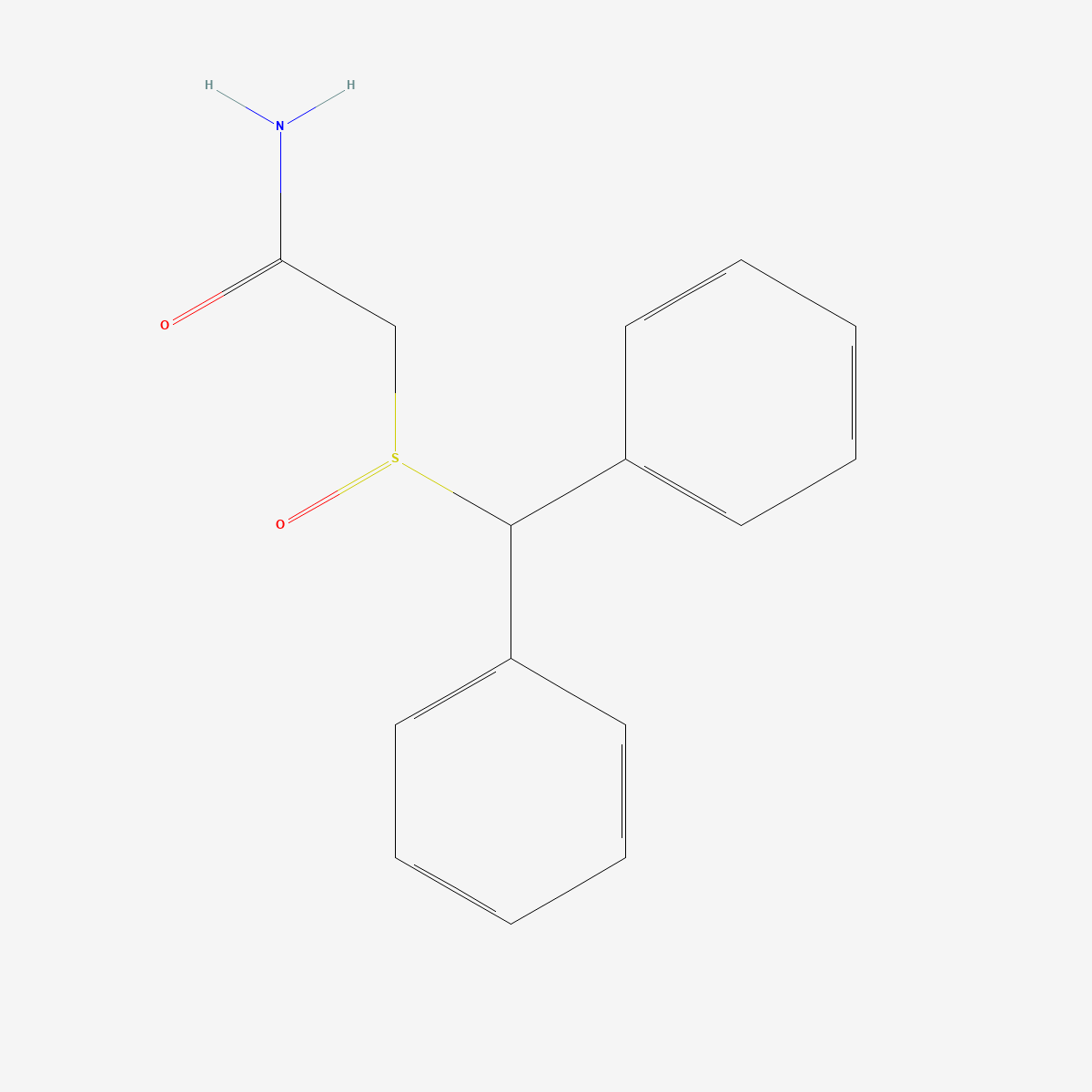
The half-life usually quoted for modafinil — twelve to fifteen hours — is an average over two molecules that do not behave alike. Modafinil is a racemate, and its enantiomers are cleared at substantially different rates: in the original ascending-dose study one enantiomer was eliminated roughly three times faster than the other. A single number therefore conceals the central fact of this compound’s disposition, which is that the circulating pool changes composition over the dosing interval and becomes progressively enriched in the slower enantiomer. Almost everything else that is interesting about modafinil pharmacokinetics — why armodafinil is not simply half a dose, why the enzyme-induction signal shows up where it does — follows from that asymmetry or from the fact that the main clearance route is not a cytochrome P450 reaction at all.
Key points
- Compound: modafinil, CAS 68693-11-8, C15H15NO2S, MW 273.35, supplied as the racemate.
- Basic disposition: readily absorbed, maximum plasma concentrations at 2–4 hours, steady state within 2–4 days, dose-independent kinetics between 200 and 600 mg/day, elimination half-life approximately 12–15 hours largely reflecting the longer-lived enantiomer.[1]
- Clearance route: metabolism, chiefly amide hydrolysis to modafinil acid, with lesser contributions from CYP-mediated oxidation. Less than 10% of a dose is excreted unchanged.[1]
- Stereochemistry: one enantiomer is eliminated about threefold faster than the other;[2] reported half-lives are approximately 15 hours for the R-isomer and 4–5 hours for the S-isomer.[6]
- Enzyme effects: competitive, reversible inhibition of CYP2C19 with a Ki of 39 µM in vitro, and up to twofold induction of CYP1A2, CYP2B6 and CYP3A4/5 in primary human hepatocytes;[3] CYP3A4/5 induction confirmed in vivo, with the effect appearing to be more gastrointestinal than hepatic.[4]
- Status: supplied as a reference standard for laboratory research. Not a medicine and not for human or animal consumption.
Absorption, steady state and the shape of the dose–exposure relationship
The defining pharmacokinetic study is a randomised, double-blind, placebo-controlled ascending-dose evaluation in healthy male volunteers, with eight subjects per dose group (six active, two placebo) receiving 200, 400, 600 or 800 mg once daily for seven days. Serial sampling on day 1 and day 7, with trough samples on the intervening days, produced the parameters that still anchor the field: steady state reached after three daily doses, plasma clearance of approximately 50 mL/min, volume of distribution of approximately 0.8 L/kg and a half-life of approximately 15 hours, with kinetics that were dose- and time-independent across the whole 200–800 mg range. Modafinil acid was the major urinary metabolite. The 800 mg panel was discontinued after three days following observation of increased blood pressure and pulse rate, and the authors concluded that the maximum tolerable single daily oral dose without titration may be 600 mg.[2]
Two features of that result are worth separating. Linearity across a fourfold dose range means that saturable processes — transporter-mediated absorption, capacity-limited metabolism — are not in play at these exposures. Time-independence means autoinduction of the compound’s own clearance is not detectable over a week, despite modafinil being an inducer of several CYP enzymes. That combination is unusual and it is explained by the metabolic route: if the dominant clearance pathway is amide hydrolysis rather than oxidation, then inducing oxidative enzymes does relatively little to the parent compound’s own elimination.[1]
Two enantiomers, two half-lives, one plasma concentration
The ascending-dose study reported stereospecific pharmacokinetics explicitly: the d-enantiomer was eliminated at a threefold faster rate than the l-enantiomer.[2] The clinical pharmacokinetic review makes the corollary explicit — the 12–15 hour figure is largely reflective of the longer-lived l-enantiomer.[1] Later work using R/S nomenclature places the half-life of the R-isomer at approximately 15 hours and that of the S-isomer at 4–5 hours, and notes that the two isomers are equipotent, producing equivalent pharmacological activity at equal concentrations.[6]
Read together, these describe the same asymmetry under two labelling conventions, with the longer-lived species designated l- in the earlier literature and R- in the later. That naming shift is a genuine trap when comparing papers across decades, because optical rotation descriptors and Cahn–Ingold–Prelog descriptors are assigned by unrelated criteria and their correspondence has to be established for each compound rather than assumed.
The practical consequence for anyone interpreting plasma data is that an achiral assay on a racemate measures a moving mixture. Immediately after a dose the sample is close to 50:50; late in the dosing interval the faster enantiomer has largely gone and the measured concentration is mostly the slower one. Total-modafinil concentrations at two time points are therefore not comparable in composition, even when they are identical in magnitude. Any pharmacokinetic–pharmacodynamic analysis that assumes a constant relationship between total concentration and active species is making an assumption the chemistry does not support.
Metabolism: hydrolysis first, oxidation second
Modafinil is eliminated primarily by metabolism in the liver with subsequent urinary excretion of metabolites, and the principal reaction is amide hydrolysis rather than CYP-mediated oxidation.[1] The two metabolites that matter analytically are modafinil acid, the hydrolysis product and the major urinary species,[2] and modafinil sulfone, the oxidation product at sulfur.
A population pharmacokinetic analysis gives the clearest picture of how the three species relate. Eighty healthy volunteers were randomised to four oral regimens — three doses of 50 mg, three of 100 mg, two of 200 mg plus one placebo, or three placebo doses, each given eight-hourly — with blood sampled to 58 hours after the first dose. The data were best described by a five-compartment structure: two compartments for modafinil with first-order absorption from a gut compartment, and one compartment each for modafinil acid and modafinil sulfone. Body weight emerged as a covariate influencing the central and peripheral volumes for modafinil, and all parameters were estimated with relative standard errors below 39%.[5]
That the metabolites required their own compartments, rather than being treated as instantaneous outputs, is the useful detail: they have their own disposition kinetics and their time courses do not track the parent’s.
Modafinil as a perpetrator of interactions
The in vitro characterisation is unusually complete. Across CYP1A2, 2A6, 2B6, 2C9, 2C19, 2D6, 2E1, 3A4/5 and 4A9/11 in pooled human liver microsomes at 5–250 µM, modafinil showed minimal inhibitory capacity except toward CYP2C19, where it inhibited S-mephenytoin 4′-hydroxylation reversibly and competitively with a Ki of 39 µM — a value the authors noted approximates the steady-state maximum plasma concentration at 400 mg/day. No irreversible or metabolism-dependent inhibition was observed. In primary human hepatocyte cultures exposed to 10–300 µM, mean activities of CYP1A2, CYP2B6 and CYP3A4/5 rose up to twofold relative to solvent controls, though less than with reference inducers, while CYP2C9 activity fell by up to 60% at concentrations of 100 µM and above.[3]
The in vivo test of the induction signal is instructive about where induction actually happens. Forty-one women receiving long-term oral contraception containing ethinylestradiol 0.035 mg and norgestimate 0.180–0.250 mg were given modafinil 200 mg for 7 days followed by 400 mg for 21 days, or placebo for 28 days, with pharmacokinetic profiling of steady-state ethinylestradiol and of a single 0.125 mg dose of triazolam before and after. Triazolam showed a marked decrease in maximum concentration and in area under the curve, together with a shortened half-life. Ethinylestradiol showed a much smaller decrease in exposure and no apparent change in half-life. The authors concluded that CYP3A4/5 induction had occurred in humans but appeared more gastrointestinal than hepatic in nature, so that substantial interactions are most likely with compounds undergoing significant gastrointestinal CYP3A4/5-mediated first-pass metabolism — triazolam being the archetype.[4]
A modern study puts a magnitude on the effect in patients. In eleven pharmacokinetically evaluable patients with BRAF V600-mutant advanced solid tumours, modafinil 400 mg once daily given on days 15 through 21 decreased encorafenib maximum concentration by 20.2% and area under the curve to the last measurable concentration by 23.8%, with exposure to the metabolite LHY746 not substantially changed; the authors characterised the effect as weak and concluded that encorafenib can be co-administered with a moderate CYP3A4 inducer without dose adjustment.[7] Modafinil is thus an induction perpetrator of modest and quantified magnitude rather than a strong one — a distinction that matters when it is used as a probe compound in interaction work.
Armodafinil is not half a dose of modafinil
The intuition that giving 200 mg of the single R-isomer should resemble giving 200 mg of a racemate containing 100 mg of it is wrong, and the discrepancy has been measured directly. In an open-label crossover study in 42 patients with excessive sleepiness associated with treated obstructive sleep apnoea, mean terminal half-lives were 16.5 hours (SD 4.44) for armodafinil and 14.4 hours (SD 3.22) for modafinil, but systemic exposure differed far more than that: mean AUC0–∞ was 108.8 µg·h/mL (SD 31.66) for armodafinil against 66.4 µg·h/mL (SD 20.06) for modafinil at the same 200 mg dose. The single-dose AUC0–∞ ratio was 1.64 (95% CI 1.60–1.68), the multiple-dose AUC0–τ ratio 1.69 (95% CI 1.65–1.72) and the multiple-dose Cmax ratio 1.37 (95% CI 1.33–1.41). The confidence intervals fell outside the 80–125% window, so the two formulations do not meet regulatory criteria for bioequivalence.[6]
The mechanism is straightforward once the enantiomer half-lives are in hand. The short-lived isomer contributes to early exposure and then leaves; the long-lived isomer accumulates. Replacing the racemate with the long-lived isomer alone therefore raises total exposure disproportionately and shifts the concentration–time profile later in the day.
Measuring it: what the assay has to resolve
The first published bioanalytical method for this compound determined modafinil and its acid metabolite simultaneously in human plasma by liquid–liquid extraction followed by isocratic reversed-phase HPLC with ultraviolet detection at 236 nm, using an acetonitrile–water–acetic acid eluent. It achieved a detection limit of 0.04 mg/L for both analytes, quantitation limits of 0.13 mg/L for modafinil and 0.14 mg/L for the acid, and linearity from 0.1 to 20 mg/L.[8] Methods of this class support clinical pharmacokinetic work well, and the crossover comparison of armodafinil and modafinil was itself analysed by achiral HPLC with ultraviolet detection.[6]
The limitation is the one identified above. An achiral method cannot see the enantiomer ratio, so it cannot distinguish a sample that is 50:50 from one that is 90:10 at the same total concentration. Work in which the stereochemical composition is part of the question — comparison of racemate with single isomer, late-interval sampling, or any attempt to relate concentration to effect across a full dosing interval — requires a stereospecific method, as the original ascending-dose study used.[2] A broader survey of the compound’s pharmacokinetics and pharmacodynamics, including forensic aspects, is available for readers who need the wider context.[9]
Frequently asked questions
What is the half-life of modafinil?
Approximately 12–15 hours for the racemate, but that figure is dominated by the longer-lived enantiomer.[1] Measured separately, the R-isomer has a half-life of about 15 hours and the S-isomer about 4–5 hours.[6] Quoting a single number for a racemate is convenient but loses the information that matters most for interpreting late-interval samples.
Does modafinil induce CYP3A4?
Yes, and the induction has been characterised in both directions. In vitro, primary human hepatocyte cultures showed up to twofold increases in CYP3A4/5 activity, less than with reference inducers.[3] In vivo, triazolam exposure fell markedly while ethinylestradiol exposure fell much less, which pointed to induction predominantly in the gastrointestinal tract rather than the liver.[4] In a patient study, modafinil 400 mg daily reduced encorafenib exposure by around 20–24%.[7]
Why does modafinil accumulate so little relative to its enzyme-inducing properties?
Because its own clearance runs mainly through amide hydrolysis rather than oxidative metabolism, inducing CYP enzymes does comparatively little to the parent compound’s elimination. Its pharmacokinetics were dose- and time-independent across 200–800 mg over seven days, with no autoinduction detectable.[1][2]
What should a modafinil reference standard used in pharmacokinetic work provide?
A stated assay with the method behind it, and clarity that the material is the racemate rather than a single isomer, since the distinction changes both the expected chromatography and the interpretation of any exposure comparison. Our modafinil reference material (CAS 68693-11-8) is supplied with identity and purity documentation available on request.
Related compounds in our catalogue
Researchers comparing wakefulness-associated compounds across mechanisms commonly work alongside bromantane reference standard (CAS 87913-26-6), whose proposed mechanism operates through enzyme expression rather than transporter binding, and the fluorinated modafinil analogue FLmodafinil (CAS 90280-13-0), useful when the question is how ring substitution alters metabolic stability.
References
- Robertson P Jr, Hellriegel ET. Clinical pharmacokinetic profile of modafinil. Clinical Pharmacokinetics. 2003;42(2):123–137. doi:10.2165/00003088-200342020-00002 · PMID: 12537513
- Wong YN, Simcoe D, Hartman LN, Laughton WB, King SP, McCormick GC, Grebow PE. A double-blind, placebo-controlled, ascending-dose evaluation of the pharmacokinetics and tolerability of modafinil tablets in healthy male volunteers. Journal of Clinical Pharmacology. 1999;39(1):30–40. doi:10.1177/00912709922007534 · PMID: 9987698
- Robertson P, DeCory HH, Madan A, Parkinson A. In vitro inhibition and induction of human hepatic cytochrome P450 enzymes by modafinil. Drug Metabolism and Disposition. 2000;28(6):664–671. PMID: 10820139
- Robertson P Jr, Hellriegel ET, Arora S, Nelson M. Effect of modafinil on the pharmacokinetics of ethinyl estradiol and triazolam in healthy volunteers. Clinical Pharmacology and Therapeutics. 2002;71(1):46–56. doi:10.1067/mcp.2002.121217 · PMID: 11823757
- Seng KY, Fan L, Lee HS, Yong WP, Goh BC, Lee LS. Population pharmacokinetics of modafinil and its acid and sulfone metabolites in Chinese males. Therapeutic Drug Monitoring. 2011;33(6):719–729. doi:10.1097/FTD.0b013e318237a9e9 · PMID: 22105589
- Darwish M, Kirby M, D’Andrea DM, Yang R, Hellriegel ET, Robertson P Jr. Pharmacokinetics of armodafinil and modafinil after single and multiple doses in patients with excessive sleepiness associated with treated obstructive sleep apnea: a randomized, open-label, crossover study. Clinical Therapeutics. 2010;32(12):2074–2087. doi:10.1016/j.clinthera.2010.11.009 · PMID: 21118743
- Piscitelli J, Reddy MB, Wollenberg L, Del Frari L, Gong J, Matschke K, Williams JH. Evaluation of the effect of modafinil on the pharmacokinetics of encorafenib and binimetinib in patients with BRAF V600-mutant advanced solid tumors. Cancer Chemotherapy and Pharmacology. 2024;94(3):337–347. doi:10.1007/s00280-024-04676-2 · PMID: 38878209
- Moachon G, Matinier D. Simultaneous determination of modafinil and its acid metabolite by high-performance liquid chromatography in human plasma. Journal of Chromatography B: Biomedical Applications. 1994;654(1):91–96. doi:10.1016/0378-4347(93)e0452-v · PMID: 7911706
- Sousa A, Dinis-Oliveira RJ. Pharmacokinetic and pharmacodynamic of the cognitive enhancer modafinil: relevant clinical and forensic aspects. Substance Abuse. 2020;41(2):155–173. doi:10.1080/08897077.2019.1700584 · PMID: 31951804
Research use only. The compounds discussed are supplied as reference standards for laboratory research. They are not medicines, not dietary supplements, and are not for human or animal consumption. Nothing in this article is medical advice or a recommendation for use in humans. Any quantities mentioned are those reported in the published studies cited above and appear solely to describe that research accurately.