One hour after rats received 5 mg/kg of noopept intraperitoneally, the administered compound could not be found in their brains at all — it sat below the detection limit of the HPLC method used. What had changed was the concentration of cyclo-L-prolylglycine, which had risen roughly 2.5-fold. That single observation reorganises the whole pharmacokinetic picture: noopept behaves as a prodrug, and the species that correlates with effect is a cyclic dipeptide the brain already produces on its own. Tracking the administered molecule, the default move in any pharmacokinetic study, is close to the least informative measurement available here.
Key points
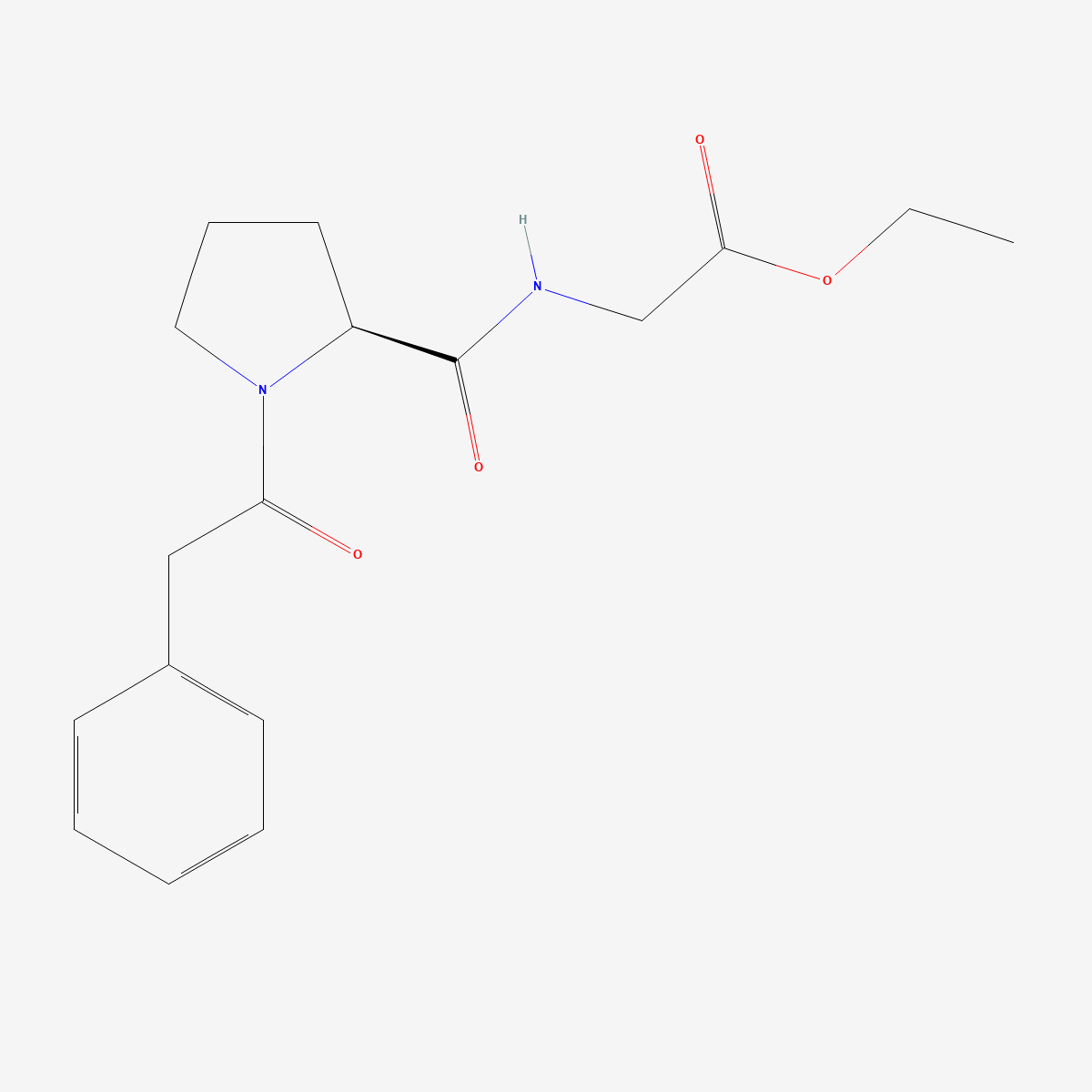
- Compound: noopept, CAS 157115-85-0, C17H22N2O4, MW 318.4 — the ethyl ester of N-phenylacetyl-L-prolylglycine, carrying the development code GVS-111 in most of the primary literature.
- Active species: cyclo-L-prolylglycine (CPG), formed by enzymatic conversion in the presence of plasma and brain enzymes, and identical to an endogenous cyclopeptide.[1]
- The measurement problem: CPG and the other candidate metabolites are present in untreated control brain as well, so the analytical task is detecting a change in an endogenous background rather than detecting a foreign analyte.[1]
- Unresolved point: one study reports the intact dipeptide crossing the blood–brain barrier unmodified after oral dosing,[2] while another failed to detect the parent in brain after intraperitoneal dosing.[1] The indexed literature does not settle this.
- Species differences are large: elimination slows progressively from rat to rabbit to human, and the phenyl-ring-hydroxylated metabolite prominent in rats is absent in rabbits.[4]
- Status: supplied as a reference standard for laboratory research. Not a medicine and not for human or animal consumption.
What is administered and what is present
The metabolism study that established the prodrug interpretation is Gudasheva and colleagues, 1997. After 5 mg/kg intraperitoneally in rats, GVS-111 itself was not found in brain at one hour up to the limit of detection under the HPLC conditions used. Three substances corresponding to the three plausible metabolites — phenylacetic acid, prolylglycine and cyclo-prolylglycine — were found by HPLC, gas chromatography and GC-MS in the brains of treated animals and in controls alike. Of the three, only cyclo-prolylglycine increased, by a factor of about 2.5. Formation of cyclo-prolylglycine from GVS-111 was then demonstrated in vitro in the presence of plasma and brain enzymes. The authors concluded that GVS-111 is a prodrug converting in the body to cyclo-prolylglycine, which is identical to the endogenous cyclopeptide.[1]
An earlier pharmacokinetic study in rats, using HPLC together with gas–liquid chromatography, had already found the unchanged compound plus three metabolites in plasma and identified cyclo-Pro-Gly as the active one. It also noted something that is easy to overlook: the compound showed greater resistance to enzymatic attack than natural neuropeptides do.[3] That is the point of the molecular design. A peptide sufficiently stable to survive absorption, yet labile enough to release its active fragment afterwards, is a narrow target, and the whole pharmacokinetic profile sits on that balance.
A review of the compound’s disposition frames the problem the design was meant to solve. Peptide drugs are characterised by enzymatic instability, low bioavailability and poor permeability across the blood–brain barrier; the development strategy was to build short di- and tripeptides on natural neuropeptide templates with improved properties on all three counts. In rats, the metabolite found in plasma and brain, cyclo-prolyl-L-glycine, differs significantly from noopept in its pharmacokinetic parameters while sharing its multicomponent spectrum of pharmacological action, specifically the influence on higher integrative functions of memory.[5]
Where the literature disagrees with itself
An honest account has to flag a tension rather than smooth it over. Boiko and colleagues reported in 2000 that after oral administration the dipeptide is absorbed in the gastrointestinal tract, enters the circulation and penetrates the blood–brain barrier in an unmodified state, as determined by HPLC in rats.[2] That sits awkwardly beside the 1997 finding that the parent was undetectable in brain one hour after intraperitoneal dosing.[1]
Several reconciliations are possible and none is established in the indexed record. The route differs, oral against intraperitoneal, and the first-pass profiles differ accordingly. The sampling times may not be comparable: a compound that reaches the brain and is then hydrolysed would be present early and absent at one hour. Assay sensitivity differs between laboratories and across a three-year gap, and a non-detection is a statement about a detection limit rather than about an absence.
The distinction matters for study design more than for interpretation of effect. If the parent reaches brain tissue and is hydrolysed there, brain CPG derives partly from local conversion; if it does not, brain CPG must be delivered from the periphery or generated at the barrier. Those two models predict different time courses and different sensitivity to peripheral esterase activity, and they are distinguishable experimentally — by early brain sampling with a sensitive stereospecific assay — but the experiment does not appear to have been reported.
Species differences large enough to invalidate extrapolation
Interspecies comparison gives the clearest warning against carrying rodent numbers across. Significant differences in noopept pharmacokinetics manifest as a decrease in elimination rate on passing from rats to rabbits to humans. In rats, intravenous administration produced very intensive metabolism, with presystemic elimination mechanisms generating a specific metabolite hydroxylated at the phenyl ring. In rabbits, unchanged noopept circulated in blood for longer after both intravenous and oral administration, biotransformation proceeded much more slowly, and no metabolite analogous to the rat one was detected. In humans, elimination was slower still and showed considerable individual variability, and no drug metabolites were found in plasma — which the authors attributed to the relatively small dose and the low resulting concentration rather than to an absence of metabolism.[4]
That last clause deserves emphasis because it is a methodological statement disguised as a result. “No metabolites detected” here is an assay-sensitivity finding, and the authors say so. Reported as a bare fact it would suggest that humans do not metabolise the compound, which is the opposite of what the data support.
The presence of a species-specific oxidative pathway in rats that is absent in rabbits also means the rat is not a conservative model for this compound. A metabolite that dominates rat disposition may be irrelevant in other species, and the safety and exposure implications differ accordingly.
Prodrug and metabolite are not interchangeable
It would be tidy if noopept were simply a delivery vehicle for CPG, with all pharmacology attributable to the metabolite. The behavioural data do not support that simplification.
After oral administration, GVS-111 retained the antiamnesic activity previously observed with parenteral dosing, over effective doses of 0.5–10 mg/kg in rats trained on passive avoidance. In a specially developed active-avoidance model using a massive one-session learning schedule, the compound stimulated one-session learning after a single administration, and after repeated administration increased the number of successful learners among animals that had failed initial training. The authors state that in this respect GVS-111 differs in principle from its main metabolite cycloprolylglycine and from piracetam.[6]
Electrophysiology points the same way with finer resolution. Measuring the transcallosal evoked potential in rat brain, piracetam at 150–300 mg/kg raised the amplitude to a maximum at 1.5–2 hours followed by gradual decline, while both noopept and cyclo-L-prolylglycine raised it to a plateau sustained across the whole observation period of more than 3.5 hours. Piracetam and cyclo-L-prolylglycine increased both components of the evoked potential to approximately equal extents, whereas noopept produced a somewhat greater increase in the negative wave.[7] Parent and metabolite share a time course but are separable in the shape of their effect.
Work on the molecular level adds a further species to the accounting. In HEK293 cells transiently transfected with luciferase reporter constructs, noopept at 10 µM increased the DNA-binding activity of HIF-1 alone among CREB, NFAT, NF-κB, p53, STAT1, GAS, VDR, HSF1 and HIF-1, with an additional concentration-dependent increase under cobalt chloride-induced HIF-1 stabilisation; piracetam at 1 mM affected none of the transcription factors tested. Molecular docking indicated that the L-isomer of noopept and the L-isomer of its N-phenylacetylprolyl metabolite — but not the pharmacologically ineffective D-isomer — can bind the active site of prolyl hydroxylase 2.[8] Whatever weight one places on docking, the study names a metabolite other than CPG as a candidate active species, which means the metabolic scheme should not be treated as closed.
Consequences for handling and for assay design
The molecule carries an ethyl ester and two amide bonds. The lability that makes it a prodrug in vivo is a stability liability in vitro, and the two cannot be separated because they are the same chemistry. Aqueous stock solutions at neutral to basic pH are the obvious hydrolysis risk, and freshly prepared solutions held cold are the sensible default; where a stock must be stored, an aprotic solvent removes the most direct hydrolysis route.
Two analytical requirements follow, and neither is optional for this compound.
First, any content assay must be stability-indicating in the specific sense of resolving the free acid, N-phenylacetyl-L-prolylglycine, from the parent ester. Ester hydrolysis in the vial does not change the sample’s appearance and shifts mass only slightly; a method that co-elutes the acid with the ester will report degraded material as intact. For reference, protonated noopept appears at m/z 319.1652 for C17H23N2O4+, and the corresponding acid differs by the ethyl group — a 28 Da difference that mass spectrometry resolves easily, provided the chromatography presents the two peaks separately rather than as one.
Second, in biological matrices the presence of CPG is not evidence of dosing. The 1997 study found all three candidate metabolites in control brain, and the experimental signal was a 2.5-fold rise against that background.[1] Any study reading out CPG therefore needs baseline samples from the same animals or a matched control group, and the analytical figure of merit that matters is precision around the endogenous concentration rather than the limit of detection in clean solvent. This is a harder bioanalytical problem than a conventional xenobiotic assay, and it is intrinsic to the compound rather than a limitation of any particular method.
Frequently asked questions
What is the active metabolite of noopept?
Cyclo-L-prolylglycine. It is formed from noopept in the presence of plasma and brain enzymes, rises about 2.5-fold in rat brain after dosing, and is identical to an endogenous cyclopeptide.[1] Its pharmacokinetic parameters differ substantially from those of the parent while its pharmacological spectrum overlaps.[5] A second metabolite, N-phenylacetylprolyl, has also been proposed as pharmacologically relevant.[8]
Does noopept cross the blood–brain barrier intact?
The indexed literature is not consistent on this. One rat study reports absorption from the gastrointestinal tract, entry into the circulation and passage across the barrier in unmodified form after oral dosing.[2] Another failed to detect the parent in brain one hour after intraperitoneal dosing at 5 mg/kg.[1] Route, sampling time and assay sensitivity all differ between them, and the question has not been resolved by a study designed to address it directly.
Why do rodent and human noopept pharmacokinetics differ so much?
Elimination slows progressively from rat to rabbit to human. Rats show very intensive metabolism after intravenous dosing and produce a phenyl-ring-hydroxylated metabolite that rabbits do not; human elimination is slower still and highly variable between individuals.[4] Rodent exposure parameters therefore do not transfer, and the rat is not a conservative model for this compound.
What should a noopept reference standard provide?
An assay value with the method that produced it, chromatographic evidence that the free acid is resolved from the ester, and storage guidance appropriate to a hydrolysable compound. Our noopept reference material (CAS 157115-85-0) is supplied with identity and purity documentation available on request; for work spanning weeks, laboratories should plan to re-check content rather than assume the initial assay still applies.
Related compounds in our catalogue
Comparative work on this family regularly runs noopept against the reference compounds used in the primary literature, including aniracetam reference standard (CAS 72432-10-1), itself rapidly hydrolysed to ring-opened metabolites, and oxiracetam (CAS 62613-82-5), which is far more hydrolytically stable and makes a useful negative control when ester lability is the variable under study.
References
- Gudasheva TA, Boyko SS, Ostrovskaya RU, Voronina TA, Akparov VK, Trofimov SS, Rozantsev GG, Skoldinov AP, Zherdev VP, Seredenin SB. The major metabolite of dipeptide piracetam analogue GVS-111 in rat brain and its similarity to endogenous neuropeptide cyclo-L-prolylglycine. European Journal of Drug Metabolism and Pharmacokinetics. 1997;22(3):245–252. doi:10.1007/BF03189814 · PMID: 9358206
- Boiko SS, Ostrovskaya RU, Zherdev VP, Korotkov SA, Gudasheva TA, Voronina TA, Seredenin SB. Pharmacokinetics of new nootropic acylprolyldipeptide and its penetration across the blood-brain barrier after oral administration. Bulletin of Experimental Biology and Medicine. 2000;129(4):359–361. doi:10.1007/BF02439270 · PMID: 10977920
- Boĭko SS, Zherdev VP, Dvorianinov AA, Gudasheva TA, Ostrovskaia RU, Voronina TA, Rozantsev GG, Seredenin SB. The pharmacokinetics of the dipeptide analog of piracetam with nootropic activity GVS-111 and of its basic metabolites. Eksperimental’naia i Klinicheskaia Farmakologiia. 1997;60(2):53–55. PMID: 9206571
- Boĭko SS, Korotkov SA, Zherdev VP, Gudasheva TA, Ostrovskaia RU, Voronina TA. Interspecies differences of noopept pharmacokinetics. Eksperimental’naia i Klinicheskaia Farmakologiia. 2004;67(1):40–43. PMID: 15079908
- Boyko SS, Zherdev VP, Shevchenko RV. Pharmacokinetics of noopept and its active metabolite cycloprolyl glycine in rats. Biomeditsinskaia Khimiia. 2018;64(5):455–458. doi:10.18097/PBMC20186405455 · PMID: 30378564
- Ostrovskaya RU, Mirsoev TK, Romanova GA, Gudasheva TA, Kravchenko EV, Trofimov CC, Voronina TA, Seredenin SB. Proline-containing dipeptide GVS-111 retains nootropic activity after oral administration. Bulletin of Experimental Biology and Medicine. 2001;132(4):959–962. doi:10.1023/a:1013663126973 · PMID: 11782792
- Molodavkin GM, Borlikova GG, Voronina TA, Gudasheva TA, Ostrovskaia RU, Tushmalova NA, Seredenin SB. Effect of the novel dipeptide nootropic agent noopept and its metabolite cyclo-L-prolylglycine on the transcallosal evoked potential in the rat brain. Eksperimental’naia i Klinicheskaia Farmakologiia. 2002;65(2):3–5. PMID: 12109288
- Vakhitova YV, Sadovnikov SV, Borisevich SS, Ostrovskaya RU, Gudasheva TA, Seredenin SB. Molecular mechanism underlying the action of substituted Pro-Gly dipeptide noopept. Acta Naturae. 2016;8(1):82–89. PMID: 27099787
Research use only. The compounds discussed are supplied as reference standards for laboratory research. They are not medicines, not dietary supplements, and are not for human or animal consumption. Nothing in this article is medical advice or a recommendation for use in humans. Any quantities mentioned are those reported in the published studies cited above and appear solely to describe that research accurately.