Mass spectrometry identifies FLModafinil in one injection. It measures the elemental composition, separates it cleanly from modafinil by 36 mass units, and resolves it from fladrafinil by the extra oxygen. What it cannot do is see the thing that every published pharmacology study on this scaffold treated as decisive: the sulfoxide sulfur is a stereocentre, all four in-vivo experiments used a resolved single enantiomer, and CAS 90280-13-0 carries no stereodescriptor at all. A certificate of analysis built entirely on mass spectrometry therefore answers a question about formula while leaving the question the literature actually turns on untouched.
Key points
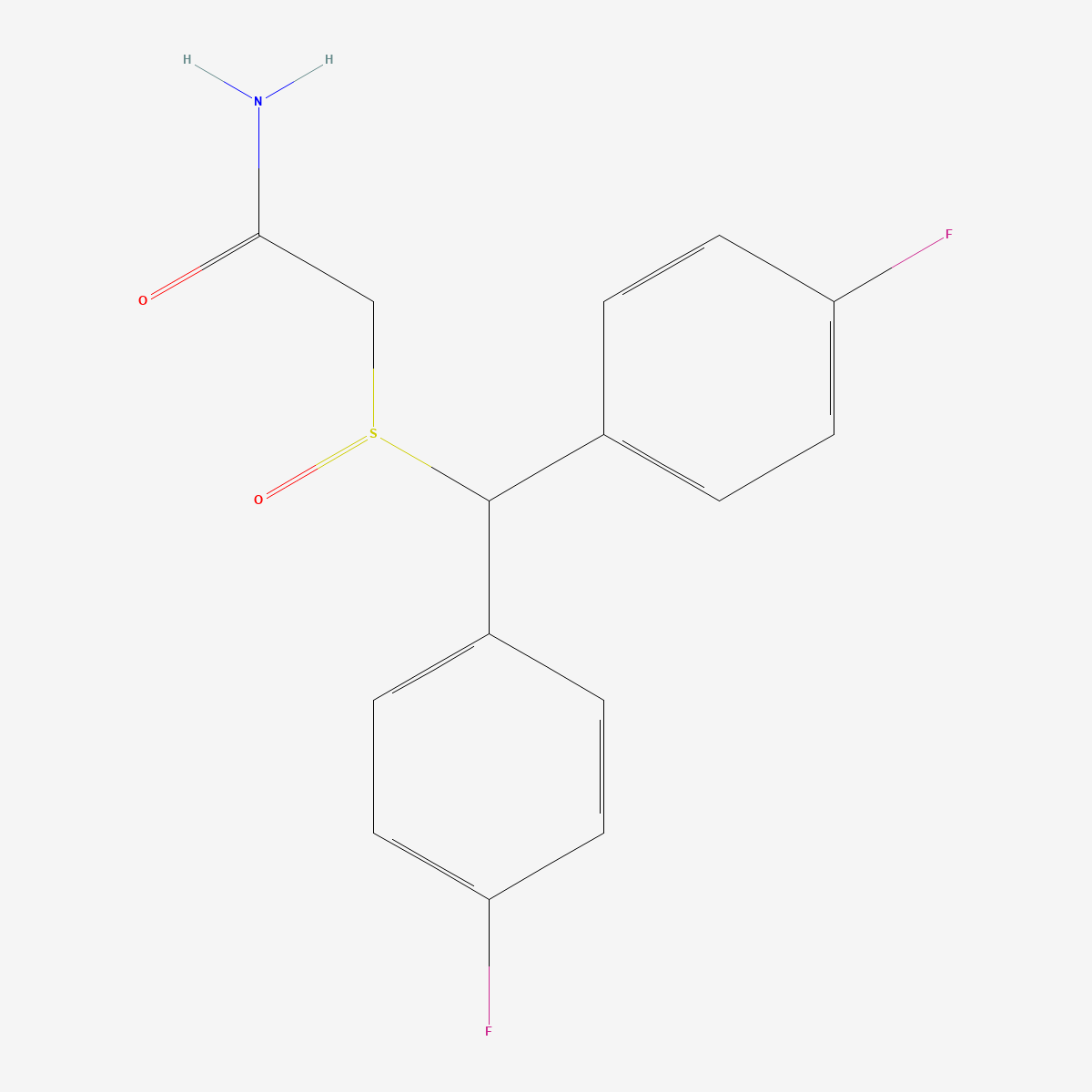
- Identity: 2-[bis(4-fluorophenyl)methylsulfinyl]acetamide, also designated CRL-40,940 and lauflumide (CAS 90280-13-0, C15H13F2NO2S, MW 309.3) — modafinil with a fluorine at the para position of each phenyl ring.
- Mass separates the family trivially: modafinil is C15H15NO2S at MW 273.35, FLModafinil adds two fluorines and loses two hydrogens, and fladrafinil (CRL-40,941) is the N-hydroxy analogue at one oxygen more. No two of them are isobaric.
- Stereochemistry is the open question: the sulfoxide sulfur is a stereocentre; NLS-4 was prepared by asymmetric oxidation to the (R)-sulfoxide,[3] and the CAS number in common use carries no stereodescriptor.
- A documented GC trap: in a heated gas-chromatography injector CRL-40,940 and CRL-40,941 degrade to a tetrafluoro analogue of 1,1,2,2-tetraphenylethane, and mixed injections generate a cross-reaction product corresponding to no substance present.[2]
- Human reference data exist: six volunteers ingested 20 mg; LC-HRMS achieved limits of detection between 0.2 and 4 ng/mL, and the metabolites flmodafinil acid and flmodafinil sulfone were detected, with urinary maxima of 191–891 ng/mL for the parent.[1]
- Status: supplied as a reference standard for laboratory research. Not a medicine and not for human or animal consumption.
The one human dataset, and what it fixes analytically
Everything quantitative that can be said about this compound in a human matrix comes from a single 2026 study from the Cologne anti-doping research centre. Six volunteers ingested 20 mg of either flmodafinil or fladrafinil. Urine and dried blood spot samples were analysed by liquid chromatography coupled to high-resolution mass spectrometry, with limits of detection between 0.2 and 4 ng/mL. After flmodafinil ingestion the metabolites flmodafinil acid and flmodafinil sulfone were detected; because fladrafinil acts as a prodrug for flmodafinil, the same metabolites appeared after fladrafinil as well, with a slight offset before flmodafinil reached its maximum concentration, reflecting the conversion step. Urinary maximum concentrations ranged from 191 to 891 ng/mL for flmodafinil and 52 to 111 ng/mL for fladrafinil; blood maxima were 45–98 and 11–35 ng/mL respectively. Both compounds fall under class S6 stimulants of the WADA Prohibited List, and the authors note that the relatively long detection windows of the intact drugs and their metabolites call for careful interpretation of an adverse analytical finding.[1]
Three analytical decisions in that design are worth copying. The platform is liquid chromatography, not gas chromatography, for reasons set out in the next section. The metabolite targets are the acid and the sulfone — oxidation and hydrolysis at the sulfinylacetamide end rather than on the fluorinated rings. And the matrix set includes dried blood spots alongside urine, which matters because the two concentration ranges differ several-fold here, so a method validated for one is not automatically fit for the other.
The spread within six subjects is itself informative: 191 to 891 ng/mL is a 4.7-fold range in urinary maximum from a fixed dose. Calibration ranges have to accommodate that, and a single-point check near the middle will not reveal linearity failures at either end.
The gas chromatography trap, which is a published result rather than folklore
An investigation into thermal degradation in the GC injection port examined modafinil, modafinic acid, adrafinil, CRL-40,940 and CRL-40,941 in a range of solvents. For modafinil, modafinic acid and adrafinil, the key degradation products were diphenylmethanol and 1,1,2,2-tetraphenylethane, the latter verified by independent synthesis and X-ray crystallography, with diphenylmethane and thiobenzophenone identified in some instances. Tetraphenylethane formation was attributed to a benzhydrylium ion reacting with the sulfoxide oxygen of the parent to give an oxysulfonium intermediate. The fluorinated compounds — CRL-40,940 and CRL-40,941 among them — produced the corresponding fluorinated analogue, and co-injecting a non-fluorinated with a fluorinated compound generated 4,4′-(2,2-diphenylethane-1,1-diyl)bis(fluorobenzene) as a third, cross-reaction product. The same paper reports 1H and 13C NMR characterisation of the compounds.[2]
The practical reading is blunt. A GC-MS chromatogram of this compound can be dominated by a thermal artefact rather than by the analyte, and a chromatogram of a mixture can contain a peak corresponding to a molecule that was never in the sample. An identity claim resting on GC-MS alone is therefore not safe for this scaffold. NMR, as characterised in the same study, and LC-based methods, as used in the human elimination work,[1] both avoid the problem, and the choice between them depends on whether constitution or quantification is the object.
What mass spectrometry settles, and how quickly
The compounds this molecule is confused with are not isobaric with it, and the arithmetic is worth doing once rather than gesturing at. Modafinil is C15H15NO2S, MW 273.35. FLModafinil is C15H13F2NO2S, MW 309.3 — the two para hydrogens replaced by fluorine, a difference of 36 nominal mass units. Fladrafinil is the N-hydroxy compound, one oxygen heavier. The two named metabolites move in opposite directions from the parent: the acid replaces the amide nitrogen-containing head with a carboxylic acid, and the sulfone adds an oxygen at sulfur. None of these coincide.
High-resolution measurement goes further and assigns elemental composition outright, and the two fluorines make that easier rather than harder, because fluorine’s mass defect is distinctive. Anyone presenting modafinil/FLModafinil discrimination as a hard analytical problem has not done the arithmetic. The genuinely difficult cases are elsewhere: the N-methyl-4,4-difluoro analogue known as modafiendz, which appears in the same thermal-degradation study,[2] and the enantiomers, which mass spectrometry cannot see at all.
The stereochemistry problem, stated precisely
Sulfoxides are chiral at sulfur, and this one is no exception. A review of sulfoxides in medicine discusses the benefits of using pure enantiomers — the so-called chiral switch — with proton pump inhibitors as the worked example, and treats modafinil among the sulfoxide drugs of current interest.[10] For modafinil itself the switch happened commercially: armodafinil is the single (R)-enantiomer, and a critical review of the compound’s analytical and bioanalytical methods records that the enantiomers are both biologically active but differ pharmacologically, with the S-enantiomer reported to be eliminated three times faster than the R-enantiomer, which is why manufacturers moved to the single enantiomer.[7]
For the fluorinated analogue, the same logic applies with less data behind it. The wake-promotion study describes synthesising NLS-4 by asymmetric oxidation of the thioether precursor using the Kagan method, yielding the (R)-sulfoxide.[3] Material identified by CAS 90280-13-0 carries no stereodescriptor. So a supplier’s CAS number, a molecular formula and a high-resolution mass are all mutually consistent with a racemate, with either single enantiomer, or with any mixture in between. Nothing in that package distinguishes them, and the literature was generated on a resolved enantiomer.
This is not a hypothetical concern about a difference nobody has measured. In the modafinil family, the elimination difference between enantiomers is a documented reason for a commercial chiral switch,[7] and preparative chromatography at scale has been described specifically for preparing armodafinil.[8] A laboratory buying FLModafinil to reproduce a published result obtained with the (R)-sulfoxide needs to know which entity is in the bottle, and the only way to know is to measure it.
How the sulfur is actually resolved: chiral chromatography
The relevant methods all come from the parent compound, and they transfer to the analogue as method architecture rather than as validated parameters. Four are worth knowing.
A teicoplanin macrocyclic glycopeptide stationary phase in polar organic mode separates modafinil enantiomers in under six minutes, against twelve minutes for earlier chiral HPLC methods. Using a Chirobiotic T column with methanol and triethylamine (100/0.05, v/v) at 1.0 mL/min and ultraviolet detection at 225 nm, calibration was linear above R² 0.999 over 5–150 µg/mL for each enantiomer, with limits of detection and quantification of 15 and 45 ng/mL for (R)-modafinil and 20 and 60 ng/mL for (S)-modafinil, recoveries of 100.5–102.3% and relative standard deviations of 0.4–1.0%.[4]
For biological matrices, a bidimensional achiral-chiral approach handles the sample clean-up and the resolution in one run. Coupling a restricted access medium bovine serum albumin column to an amylose tris[(S)-1-phenylethylcarbamate] chiral column allowed direct injection of human plasma and analysis, in a single run, of the modafinil enantiomers together with its two major metabolites, modafinic acid and modafinil sulphone, with the column performance maintained over more than 280 injections of 100 µL of plasma.[5] The parallel to the flmodafinil case is exact: the metabolites identified in humans are the acid and the sulfone,[1] so a method that resolves parent enantiomers and both metabolite classes in one injection is the target architecture.
Two further methods show the range of stationary phases that work. A beta-cyclodextrin column with gradient elution and ultraviolet detection at 225 nm separated d- and l-modafinil in human serum with interday and intraday variability typically 3–4% and detection and quantitation limits of 0.01 and 0.5 µg/mL, using a gradient developed to eliminate interference from methylphenidate, cocaine, common antidepressants and amphetamines; in that study d-modafinil was eliminated more rapidly than l-modafinil.[6] A normal-phase polysaccharide phase, Chiralcel OJ-H with n-hexane/ethanol 62:38 and photodiode-array detection, resolved adrafinil and modafinil enantiomers in rat serum and urine after solid-phase extraction on Oasis HLB cartridges, with recoveries at or above 80%, elution within 15 minutes free of endogenous interference and precision below 7.2% relative standard deviation; elution order was assigned with a polarimeter connected in series with the detector.[9]
That last detail — a polarimeter in series — is the point at which a chromatographic peak acquires a configuration rather than merely a retention time. A chiral separation on its own tells you there are two species in a ratio; it does not tell you which is which. Elution order has to be assigned by an optical detector, by an authentic single-enantiomer standard, or by a chiroptical or crystallographic measurement made once and carried forward.
Quantification: the internal standard problem
Quantitative LC-MS normally requires an isotopically labelled analogue of the analyte, and for a compound with five indexed papers no such standard is commercially routine. One published route around this is instructive. Deuterium labelling of armodafinil was achieved by hydrogen-deuterium exchange at carbon centres rather than by synthesis: three deuterons could be introduced, they did not back-exchange under neutral or acidic conditions, and the deuterated and non-deuterated isotopologues co-eluted chromatographically, with the degree of deuteration controllable through reaction conditions. The authors present it as a rapid, low-cost preparation of a labelled standard for quantitative LC-MS, motivated explicitly by the compound’s misuse among students and athletes.[11]
Co-elution is the property that matters there. An internal standard that separates from the analyte does not correct for matrix effects at the analyte’s retention time, which is the main thing an internal standard is for. Any laboratory building quantitative work on the fluorinated analogue faces the same requirement, and the exchange approach is at least a demonstrated starting point on the parent scaffold.
Frequently asked questions
Can mass spectrometry tell FLModafinil from modafinil?
Immediately. They are not isomers: modafinil is C15H15NO2S at MW 273.35 and FLModafinil is C15H13F2NO2S at MW 309.3, a 36-unit difference with two fluorines present in one and absent from the other. High-resolution measurement assigns the composition outright. The separation that mass spectrometry cannot make is between the two enantiomers.
Why should GC-MS not be used to confirm this compound?
Because the degradation is documented. In a heated GC injector, CRL-40,940 and CRL-40,941 generate a tetrafluoro analogue of 1,1,2,2-tetraphenylethane, and co-injection with a non-fluorinated relative produces a third cross-reaction product corresponding to no substance in the sample.[2] NMR and LC-based methods avoid the problem.
Does the stereochemistry of FLModafinil matter in practice?
The published pharmacology says so implicitly, because it was all done on resolved material: NLS-4 was prepared as the (R)-sulfoxide by asymmetric oxidation.[3] In the parent compound, the enantiomers differ pharmacologically and in elimination rate, which is why the single-enantiomer product exists.[7] No comparable enantiomer-resolved data have been published for the fluorinated analogue, which is a gap rather than a reassurance.
What should a FLModafinil reference standard be characterised for?
Assay purity by a stated method, identity confirmed by NMR or an LC-based technique rather than by GC-MS alone given the injector artefact, a high-resolution mass supporting C15H13F2NO2S, and — the item most often missing — an explicit statement of stereochemical composition, since the CAS number does not carry one. Our FLModafinil reference standard (CAS 90280-13-0) ships with identity documentation available on request, and the pharmacological background is set out in our article on FLModafinil’s mechanism of action and its six-paper evidence base.
Related compounds in our catalogue
The indispensable comparator here is modafinil reference material (CAS 68693-11-8), which supplies the chromatographic methods, the metabolite chemistry and the enantiomer behaviour that the fluorinated analogue inherits by analogy. For a prohibited compound whose analytical record runs the opposite way — extensive pharmacology, almost no published method — bromantane (CAS 87913-26-6) makes the instructive contrast.
References
- Krug O, Guddat S, Görgens C, Walpurgis K, Toma F, Thomas A, Thevis M. Investigations into the metabolism and elimination of flmodafinil and fladrafinil for sports drug testing purposes. Drug Testing and Analysis. 2026;18(8):1076–1087. doi:10.1002/dta.70100 · PMID: 42210629
- Dowling G, Kavanagh PV, Talbot B, O’Brien J, Hessman G, McLaughlin G, Twamley B, Brandt SD. Outsmarted by nootropics? An investigation into the thermal degradation of modafinil, modafinic acid, adrafinil, CRL-40,940 and CRL-40,941 in the GC injector: formation of 1,1,2,2-tetraphenylethane and its tetra fluoro analog. Drug Testing and Analysis. 2017;9(3):518–528. doi:10.1002/dta.2142 · PMID: 27928893
- Luca G, Bandarabadi M, Konofal E, Lecendreux M, Ferrié L, Figadère B, Tafti M. Lauflumide (NLS-4) is a new potent wake-promoting compound. Frontiers in Neuroscience. 2018;12:519. doi:10.3389/fnins.2018.00519 · PMID: 30158846
- Harvanová M, Gondová T. New enantioselective LC method development and validation for the assay of modafinil. Journal of Pharmaceutical and Biomedical Analysis. 2017;138:267–271. doi:10.1016/j.jpba.2017.02.028 · PMID: 28231529
- Cass QB, Ferreira Galatti T. A method for determination of the plasma levels of modafinil enantiomers, (±)-modafinic acid and modafinil sulphone by direct human plasma injection and bidimensional achiral-chiral chromatography. Journal of Pharmaceutical and Biomedical Analysis. 2008;46(5):937–944. doi:10.1016/j.jpba.2007.03.004 · PMID: 17478071
- Donovan JL, Malcolm RJ, Markowitz JS, DeVane CL. Chiral analysis of d- and l-modafinil in human serum: application to human pharmacokinetic studies. Therapeutic Drug Monitoring. 2003;25(2):197–202. doi:10.1097/00007691-200304000-00009 · PMID: 12657914
- Ramachandra B. A critical review of properties of modafinil and analytical, bioanalytical methods for its determination. Critical Reviews in Analytical Chemistry. 2016;46(6):482–489. doi:10.1080/10408347.2016.1153948 · PMID: 26908128
- Hauck W, Adam P, Bobier C, Landmesser N. Use of large-scale chromatography in the preparation of armodafinil. Chirality. 2008;20(8):896–899. doi:10.1002/chir.20564 · PMID: 18506833
- Rao RN, Shinde DD. Enantioselective separation and determination of adrafinil and modafinil on Chiralcel OJ-H column in rat serum and urine using solid-phase extraction followed by HPLC. Biomedical Chromatography. 2009;23(8):811–816. doi:10.1002/bmc.1190 · PMID: 19353685
- Wojaczyńska E, Wojaczyński J. Sulfoxides in medicine. Current Opinion in Chemical Biology. 2023;76:102340. doi:10.1016/j.cbpa.2023.102340 · PMID: 37307682
- Grocholska P, Wieczorek R, Bąchor R. Preparation of deuterium-labeled armodafinil by hydrogen-deuterium exchange and its application in quantitative analysis by LC-MS. Metabolites. 2022;12(7):578. doi:10.3390/metabo12070578 · PMID: 35888702
Research use only. The compounds discussed are supplied as reference standards for laboratory research. They are not medicines, not dietary supplements, and are not for human or animal consumption. Nothing in this article is medical advice or a recommendation for use in humans. Any quantities mentioned are those reported in the published studies cited above and appear solely to describe that research accurately.