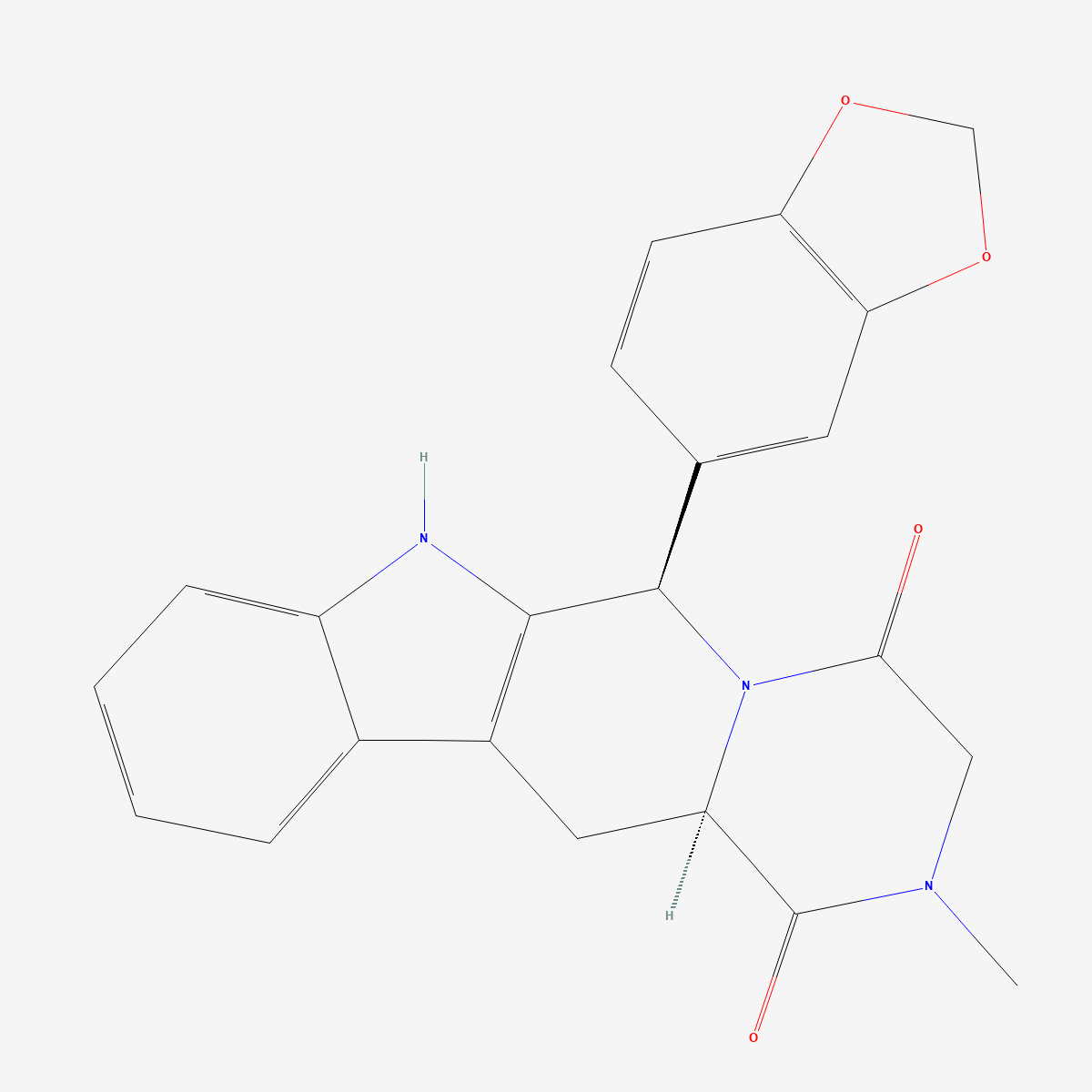
Tadalafil’s seventeen-and-a-half-hour half-life is the fact everyone knows about it, and it is almost always explained wrongly — as tissue retention, as slow release from a binding site, as something to do with the rigid fused scaffold sitting tight in the enzyme. The published parameters settle the question arithmetically. Apparent volume of distribution is 62.6 litres, which is unremarkable for a small lipophilic molecule; apparent oral clearance is 2.48 litres per hour, which is low. Put those two numbers into the standard relationship and the half-life comes out at 17.5 hours exactly. Nothing about the distribution is unusual. What is unusual is how slowly the compound is removed, and the consequences of that — for accumulation, for food effects, for what happens when CYP3A4 is induced — are what a pharmacokinetic account of this molecule has to cover.
Key points
- Compound: tadalafil, CAS 171596-29-5, C22H19N3O4, MW 389.4 — a rigid β-carboline-derived diketopiperazine, structurally unrelated to the pyrazolopyrimidinone class.
- Core parameters: mean maximum concentration 378 µg/L for a 20 mg dose at 2 hours, mean terminal half-life 17.5 hours (5th–95th percentiles 11.5–29.6), apparent oral clearance 2.48 L/h and apparent volume of distribution 62.6 L, pooled across 237 healthy subjects in 13 clinical pharmacology studies.[1]
- Linear and time-independent: exposure proportional to dose, steady state reached by day 5 on once-daily dosing, accumulation 1.6-fold — consistent with the half-life and with no autoinduction.[1]
- Clearance route: CYP3A4. The clearest in vivo evidence is induction: ten days of bosentan reduced tadalafil exposure by 41.5% in 15 healthy men.[4]
- Food: negligible effect in the registration analysis judged by 90% confidence intervals on mean ratios,[1] though a later bioequivalence-trial analysis in 189 volunteers found higher exposure and later peaks in fed subjects.[6]
- Status: supplied as a reference standard for laboratory research. Not a medicine and not for human or animal consumption.
Where the 17.5 hours comes from
The defining dataset is an integrated analysis by Forgue and colleagues of non-compartmental parameters from healthy subjects given single 2.5 to 20 mg doses across 13 clinical pharmacology studies, with 237 subjects contributing to the global averages, plus a separate multiple-dose study in which parallel groups of 15 subjects received 10 or 20 mg once daily for 10 days. Absorption was rapid, with mean maximum concentration of 378 µg/L for the 20 mg dose observed at 2 hours, after which concentrations declined nearly monoexponentially with a mean terminal half-life of 17.5 hours and 5th and 95th percentiles of 11.5 and 29.6 hours. Mean apparent oral clearance was 2.48 L/h (1.35, 4.35) and apparent volume of distribution 62.6 L (39.5, 92.1). No clinically meaningful effect of body mass index, age, gender or smoking was identified, exposure was not substantially affected by time of dosing, and parameters were proportional to dose.[1]
Those two parameters reproduce the half-life exactly: 0.693 × 62.6 L divided by 2.48 L/h is 17.5 hours. The volume corresponds to roughly 0.8–0.9 L/kg in a 70–80 kg subject, which places tadalafil among ordinary lipophilic small molecules with modest tissue distribution. The clearance, by contrast, is about 41 mL/min — well below hepatic blood flow, so this is a low-extraction compound whose elimination is governed by enzyme capacity rather than by delivery to the liver. Forgue and colleagues stated the comparison directly: systemic clearance is low relative to other phosphodiesterase 5 inhibitors.[1]
This matters because the two explanations make different predictions. If the long duration were a tissue-retention phenomenon, inhibiting or inducing the metabolising enzyme would have limited effect on the terminal phase. If it is a low-clearance phenomenon, then anything that changes CYP3A4 activity should move exposure substantially — and it does, as the interaction data below show.
A separate question, which this article does not address, is what the long exposure profile does to enzyme occupancy and to the interpretation of selectivity experiments. That belongs with the pharmacodynamics, and is discussed in our treatment of tadalafil’s selectivity profile across the phosphodiesterase families.
Linearity, steady state and a small accumulation factor
Doubling the dose therefore doubles exposure. On once-daily administration, steady state was attained by day 5 and accumulation was 1.6-fold — consistent with the observed half-life and a 24-hour dosing interval, and implying no autoinduction of the compound’s own clearance over ten days.[1]
Population analysis in patients gives the same picture with variability attached. Trocóniz and colleagues modelled data from 227 patients with mild to severe erectile dysfunction receiving 2, 5 or 10 mg as needed for 12 weeks in a phase III trial. Pharmacokinetics were linear with respect to dose and duration of treatment and a one-compartment model described the data adequately, with absorption rate 1.86 h−1, apparent oral clearance 1.6 L/h and apparent volume of distribution 63.8 L. Disposition parameters showed moderate interindividual variability of 39–45%. The only statistically significant covariate detected was serum gamma-glutamyl transferase, with clearance decreasing slightly as it rose; age, weight, smoking, alcohol, liver enzyme status, disease severity, cardiovascular condition and diabetes were all non-significant.[3]
The agreement between the healthy-subject volume of 62.6 L and the patient volume of 63.8 L is worth noting: it is unusual for a population estimate in patients to land that close to a pooled non-compartmental average in volunteers, and it supports the view that tadalafil’s disposition is simple even though its duration is long.
What “no food effect” actually means
The registration conclusion was that food had negligible effects on bioavailability, assessed by 90% confidence intervals for maximum concentration and area under the curve mean ratios.[1] That is a statement about an equivalence criterion, not an assertion that food does nothing.
Villapalos-García and colleagues make the distinction visible. In an analysis combining an exploratory candidate-gene study of 120 variants in 33 genes in 66 male volunteers from two bioequivalence trials with a confirmatory study of 189 volunteers across seven further bioequivalence trials of 20 mg tadalafil formulations, fed volunteers showed higher area under the curve, higher maximum concentration and later time to maximum concentration than fasting volunteers. Male volunteers also showed higher exposure than female volunteers in that dataset. Variants in ABCC3, CYP1A2, CES1, NUDT15, SLC22A1/A2 and UGT2B10 were nominally associated with pharmacokinetic variation but none survived correction for multiple comparisons, and the authors concluded that genetic variation did not demonstrably affect tadalafil pharmacokinetics in this population while food administration did.[6]
The two findings are compatible. A food effect can be statistically detectable in a pooled dataset of 189 subjects and still fall inside the bounds that define clinical irrelevance in a registration analysis. For laboratory work the practical reading is that fed and fasted states are not interchangeable conditions when comparing exposure between arms, even for a compound conventionally described as food-independent.
CYP3A4 is the route, and induction is the cleanest proof
Tadalafil is metabolised chiefly by CYP3A4, and the most quantitative in vivo demonstration comes from an interaction study built around an inducer rather than an inhibitor. Wrishko and colleagues gave 15 healthy men aged 19 to 52 ten consecutive days each of tadalafil 40 mg once daily, bosentan 125 mg twice daily, and the combination, in a three-period crossover. Against tadalafil alone, the combination gave tadalafil geometric mean ratios of 0.59 (90% CI 0.55–0.62) for area under the curve over the dosing interval and 0.73 (0.68–0.79) for maximum concentration, with no change in time to maximum concentration. Bosentan exposure changed by less than 20% in the other direction. The authors summarised the result as bosentan decreasing tadalafil exposure by 41.5%.[4]
Bosentan induces CYP2C9 and CYP3A4, and an unchanged time to maximum concentration alongside a large fall in exposure is the signature of increased clearance rather than altered absorption — the behaviour predicted for a low-clearance, enzyme-limited molecule.
The paediatric population model makes the same point from a different direction. Ferguson-Sells and colleagues pooled 1,430 observations from 305 adults in a phase III pulmonary arterial hypertension trial with 328 observations from 19 paediatric patients in an open-label ascending-dose study, fitting a one-compartment model parameterised in bioavailability, absorption rate constant, apparent clearance and apparent volume. Weight affected apparent volume with the allometric exponent fixed at 1 and did not affect apparent clearance; bosentan increased apparent clearance; and bioavailability decreased with increasing dose and with decreasing age.[5] Bosentan surviving as a covariate in a population model built for an entirely different purpose is independent confirmation of the crossover result.
Interaction findings do not all run in the direction the mechanism predicts, and the honest position is to report that. Kim and colleagues gave 24 healthy men tadalafil 5 mg alone, amlodipine 10 mg alone and the combination for 9 days in a randomised six-sequence crossover, sampling to 72 hours after the last dose. Tadalafil geometric mean ratios for combination over monotherapy were 1.57 (90% CI 1.46–1.68) for steady-state area under the curve and 1.34 (1.24–1.45) for steady-state maximum concentration, while amlodipine exposure was essentially unchanged at 0.93 and 0.95. The authors described the interaction as substantial with respect to tadalafil concentrations but did not establish its mechanism.[7] Amlodipine is not a classical strong CYP3A4 inhibitor, so this result is better treated as a measured effect awaiting explanation than as a confirmation of the metabolic scheme.
Which populations change exposure, and which do not
Forgue and colleagues assembled six single-dose studies in the UK, Belgium, Poland and Germany covering healthy male and female subjects, elderly subjects, and subjects with diabetes mellitus, renal impairment, end-stage renal failure or hepatic impairment, with the gender study also including 10 mg daily for 10 days. Systemic exposure in the elderly was 25% greater than in young subjects (mean AUC ratio 1.25; 90% CI 0.972–1.61). Exposure was 19% lower in subjects with diabetes mellitus than in age- and gender-matched controls. Female pharmacokinetics were essentially similar to male. Exposure in mild or moderate renal insufficiency was approximately twice that in healthy subjects, and in end-stage renal failure the mean area under the curve for the major metabolite, total methylcatechol glucuronide, was three times the healthy mean. Haemodialysis contributed negligibly to elimination of either parent or metabolite, and hepatic impairment had negligible effects on exposure.[2]
Two results in that list are counter-intuitive and worth separating. Hepatic impairment barely changes exposure to a compound cleared by a hepatic enzyme — which is what low-extraction kinetics predict when functional enzyme capacity is preserved, and a reminder that “hepatically metabolised” and “sensitive to liver disease” are different statements. Renal impairment roughly doubles exposure to a compound eliminated by metabolism, with a threefold rise in the glucuronide metabolite in end-stage disease, because the conjugate requires renal excretion even though the parent does not.
The once-daily low-dose regimen was developed on the basis of these kinetics rather than on new exposure data. Wrishko and colleagues generated plasma concentration predictions from empirical single-dose 20 mg data combined with usage patterns from as-needed trials, predicting that once-daily 5 mg would maintain therapeutic concentrations throughout the 24-hour interval, and that for men taking 20 mg at least twice weekly the daily regimen would reduce total exposure; clinical trials of 2.5 and 5 mg daily were then run to test the prediction.[8] This is an unusually explicit case of a dosing regimen derived from pharmacokinetic simulation, and it only works because the compound’s kinetics are linear and time-independent.
Frequently asked questions
Why is tadalafil’s half-life so much longer than other compounds in its class?
Because its clearance is low, not because it is retained in tissue. Apparent oral clearance is 2.48 L/h against an apparent volume of distribution of 62.6 L, and those two values reproduce the observed 17.5-hour half-life arithmetically; the volume is ordinary for a lipophilic small molecule.[1] The practical corollary is that anything altering CYP3A4 activity moves exposure substantially, as bosentan’s 41.5% reduction demonstrates.[4]
Does food affect tadalafil absorption?
The registration analysis concluded that food had negligible effects on bioavailability as judged by 90% confidence intervals on mean ratios.[1] A later analysis across nine bioequivalence trials nonetheless found significantly higher area under the curve and maximum concentration, and later time to maximum concentration, in fed compared with fasting volunteers.[6] “No clinically relevant food effect” and “no measurable food effect” are different claims, and only the first is supported.
How long does it take to reach steady state?
Five days on once-daily dosing, with 1.6-fold accumulation — both consistent with the terminal half-life and with an absence of autoinduction over a ten-day course.[1] Any in vitro or in vivo protocol intended to study steady-state behaviour therefore needs a run-in of at least that length.
What should a tadalafil reference standard provide for pharmacokinetic and analytical work?
A stated assay with the method behind it, and confirmation of stereochemical identity, since the molecule carries two defined stereocentres and the diastereomeric impurity is the one most likely to co-elute under a routine reversed-phase method. Our tadalafil reference standard assayed at ≥99% purity (CAS 171596-29-5) ships with identity documentation available on request.
Related compounds in our catalogue
Laboratories running cytochrome P450 interaction work alongside this compound commonly use modafinil reference material (CAS 68693-11-8), which acts on CYP3A4/5 in the opposite direction as an inducer, and lidocaine reference standard (CAS 137-58-6), a high-extraction CYP1A2 and CYP3A4 substrate that provides the contrasting case in which clearance is limited by hepatic delivery rather than by enzyme capacity.
References
- Forgue ST, Patterson BE, Bedding AW, Payne CD, Phillips DL, Wrishko RE, Mitchell MI. Tadalafil pharmacokinetics in healthy subjects. British Journal of Clinical Pharmacology. 2006;61(3):280–288. doi:10.1111/j.1365-2125.2005.02553.x · PMID: 16487221
- Forgue ST, Phillips DL, Bedding AW, Payne CD, Jewell H, Patterson BE, Wrishko RE, Mitchell MI. Effects of gender, age, diabetes mellitus and renal and hepatic impairment on tadalafil pharmacokinetics. British Journal of Clinical Pharmacology. 2007;63(1):24–35. doi:10.1111/j.1365-2125.2006.02726.x · PMID: 16869816
- Trocóniz IF, Tillmann C, Staab A, Rapado J, Forgue ST. Tadalafil population pharmacokinetics in patients with erectile dysfunction. European Journal of Clinical Pharmacology. 2007;63(6):583–590. doi:10.1007/s00228-007-0297-1 · PMID: 17431603
- Wrishko RE, Dingemanse J, Yu A, Darstein C, Phillips DL, Mitchell MI. Pharmacokinetic interaction between tadalafil and bosentan in healthy male subjects. Journal of Clinical Pharmacology. 2008;48(5):610–618. doi:10.1177/0091270008315315 · PMID: 18305126
- Ferguson-Sells L, Velez de Mendizabal N, Li B, Small D. Population pharmacokinetics of tadalafil in pediatric patients with pulmonary arterial hypertension: a combined adult/pediatric model. Clinical Pharmacokinetics. 2022;61(2):249–262. doi:10.1007/s40262-021-01052-8 · PMID: 34379314
- Villapalos-García G, Zubiaur P, Marián-Revilla C, Soria-Chacartegui P, Navares-Gómez M, Mejía-Abril G, Rodríguez-Lopez A, González-Iglesias E, Martín-Vílchez S, Román M, Ochoa D, Abad-Santos F. Food administration and not genetic variants causes pharmacokinetic variability of tadalafil and finasteride. Journal of Personalized Medicine. 2023;13(11):1566. doi:10.3390/jpm13111566 · PMID: 38003881
- Kim H, Lee SH, Jung J, Hong S, Lim HS. Pharmacokinetic drug interaction between amlodipine and tadalafil: an open-label, randomized, multiple-dose crossover study in healthy male volunteers. Drug Design, Development and Therapy. 2022;16:425–433. doi:10.2147/DDDT.S348897 · PMID: 35221673
- Wrishko R, Sorsaburu S, Wong D, Strawbridge A, McGill J. Safety, efficacy, and pharmacokinetic overview of low-dose daily administration of tadalafil. Journal of Sexual Medicine. 2009;6(7):2039–2048. doi:10.1111/j.1743-6109.2009.01301.x · PMID: 19453893
Research use only. The compounds discussed are supplied as reference standards for laboratory research. They are not medicines, not dietary supplements, and are not for human or animal consumption. Nothing in this article is medical advice or a recommendation for use in humans. Any quantities mentioned are those reported in the published studies cited above and appear solely to describe that research accurately.